

And here we are: the one that started it all. The book that made me fall completely head over heels in love with reading.
I enjoyed reading up to the time that I read Roald Dahl’s classic Matilda, but this was the first time I can remember being so completely and utterly engrossed in the story. With Matilda, I did not want to put it down when reading time was over. So my clever nine-year-old self stuffed the book under my shirt and scuttled off to the bathroom for just a few more minutes with this wonderful story.
Before that, the name Matilda was nothing more than a frightening childhood memory. You see, my parents took me to see the film version of Matilda when it was first released in theaters, and the movie terrified me, to the point that my mom took me out of the theater to calm me down. So imagine my parents’ surprise when I bring the book home, finish it in a day, and then proceed to beg for the movie on VHS for my birthday!
Long story short, both the book and film versions of Matilda are beloved classics in my library. I read the book several, several times over my childhood, but this was my first time re-reading it in perhaps a decade, if not more.
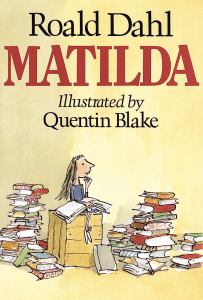
Matilda Wormwood loves to read, but her family would rather her sit in front of the TV. It isn’t until Matilda is finally allowed to go to school that she makes some real friends, including her meek but kind-hearted teacher, Miss Honey. But Matilda soon shares a common enemy with her classmates: the brutish and boorish headmistress, Miss Trunchbull. She also develops strange telekinetic powers. Matilda quickly decides how she is going to use these powers: to help her friends and boot Miss Trunchbull out of school once and for all…
Roald Dahl’s work has a real dark edge to it, and Matilda is no exception. I remember being horrified by the Trunchbull scenes as a kid, but it’s much more potent as an adult, since you’re watching this horrible woman do these dreadful things to five-year-old kids. Not to mention the Chokey, the iron maiden-like device she keeps in her office, where she locks kids away for hours at a time. It’s not that dark, all things considered; just enough to intrigue a childlike imagination.
There’s a moment where Miss Honey describes how Miss Trunchbull, who is her aunt, would hold Miss Honey’s head underwater in the bath if she didn’t wash herself properly. The horror of that statement did not really register as a kid, but adult me had to really pause. I knew it was not good to do that as a kid, but it’s enough of a graphic image to instill real horror now.
The Trunchbull is wild! I’m sure she could contend against the most dangerous of children’s literary villains. Plus, she partakes in the most iconic scenes in the book, from throwing Amanda Thripp by her pigtails over a fence, to forcing poor Bruce Bogtrotter to eat an entire 18-inch chocolate cake (this scene in the movie was horrifying as a kid).
One could argue that you just can’t take the Trunchbull seriously because she completely chews the scenery. I mean, it’s darkly amusing to watch her get so off-the-charts angry at discovering a newt in her drinking jug and expelling the first child she lays eyes on; she screams out insults for at least half a page about this one tiny incident. You almost wonder where she gets the energy to get that explosively upset time and again.
But yikes…to put such a person in charge of an elementary school is still a dreadful thought. Although, I guess Roald Dahl must have had a ball coming up with the dozens of insulting names she throws around.
Part of why I think Matilda is such an attractive story is because we’ve all felt helpless in some way against authority figures. Matilda’s parents belittle and ignore her and the Trunchbull flies off the handle so much she just can’t be reasoned with. These people abuse their authority and they think that all children, including Matilda, are disgusting bugs. It can be frustrating, especially as a child, to want something, but not have adults take you seriously or simply not listen to you. And Matilda discovering her telekinetic powers provides the sweet wish fulfillment of having some agency in such situations.
You might even consider Matilda a revenge fantasy, given all the funny ways Matilda punishes her parents for their abuse. And that all happens before she discovers her telekinesis.
Of course, that would not work if children could not see themselves in Matilda.
My memory of the character Matilda was like in the movie: looking like a girl, but feeling entirely like an adult. I think Roald Dahl did the character better, if only because Matilda still has some five-year-old mannerisms, not like in the movie, where she acts and talks very sophisticatedly. Book Matilda is still quite intelligent, but she also yammers when she gets excited and she flat-out screams at her parents and Miss Trunchbull when she gets angry. She still feels like a small girl, and that makes her more charming.
I also like how Matilda doesn’t really notice her intelligence. She is just so excited to read and consume knowledge that she doesn’t realize how unusual it is for a five-year-old to know every multiplication table or to understand nuance. Make no mistake, Matilda is still innocent. She reads adult books but doesn’t understand some of the more mature content and prefers funnier and more lighthearted stories, like most children would.
One thing did make me pause for a while.
Once Miss Honey realizes the breadth of Matilda’s talents, she invites her over to her cottage, where she tells Matilda her backstory: how her parents died when she was young and she suspects that her aunt murdered her father to get his money and his house. Miss Honey hesitates to tell Matilda this story, but she feels she can trust Matilda since she is so wise for her age.
That’s still a heavy story to be telling a five-year-old, no matter how smart she is. I know it had to happen to move the story forward, but I cannot imagine telling any child that story. Maybe I’m just overthinking, who knows?
In any case, Matilda is one of my favorite stories, not just from childhood. It’s my most-read Roald Dahl book and a pinpoint in learning to wholeheartedly love reading.

 The Library Key