

I think everyone has that one film they were shown in class that made them a little uncomfortable, and that film for me was my high school senior year Spanish class showing Como Agua Para Chocolate, or Like Water for Chocolate. It was such an explicitly erotic film that made seventeen-year-old me a little awkward, and yet, I could not get the movie out of my head for years after.
And then one day, we were going through boxes of old books in my parents’ basement, and we happened upon a hardcover copy of the book by Laura Esquivel. My curiosity piqued immediately, and I set out to rediscover one of the most erotic, but also curiously poignant, stories I’d ever encountered.
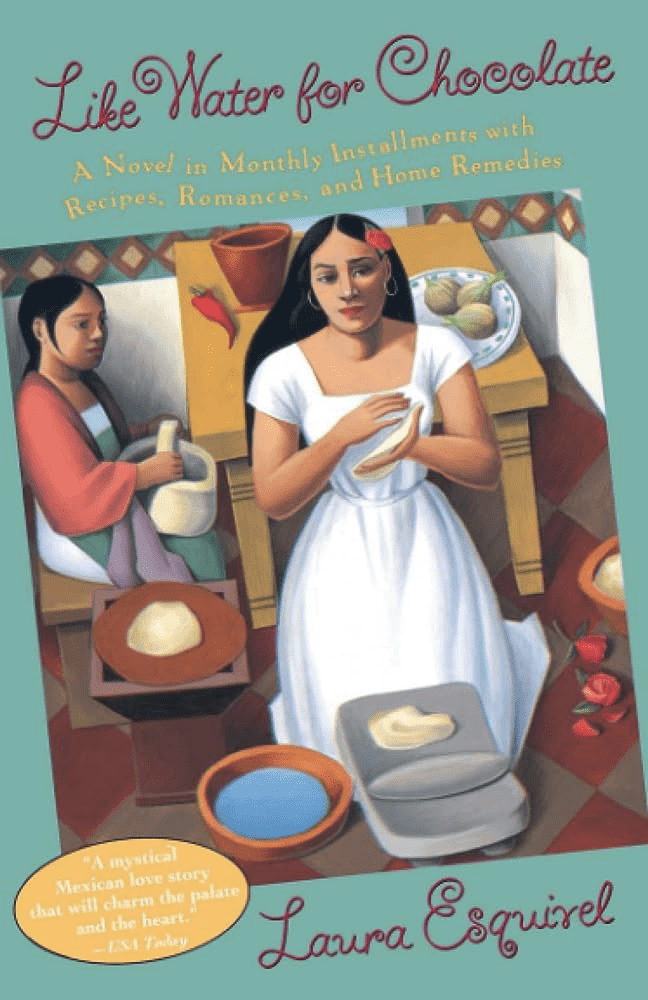
Tita de la Garza is the youngest of three daughters living with their widowed mother on a turn-of-the-century Mexican ranch. Although Tita desperately loves her family friend Pedro, tradition dictates that as the youngest daughter, she is fated to remain unmarried and take care of her physically and emotionally abusive mother, Mama Elena. Tita’s only outlet is in her extraordinary skill for cooking, and strange things happen to those who consume her food. A wedding cake prepared in sorrow induces tears. Quail in rose sauce prepared while feeling lustful induces strong sexual arousal.
I can see why this story has such tremendous appeal. Despite how certain Tita is of her love for Pedro, every authority figure tells Tita that she must accept her fate as her mother’s caretaker. Every cry for help is met with disdain or ignorance. All Tita wants is to be with the man she loves, but fate continues to conspire against them, making it harder for Tita to bear Mama Elena’s abuse.
This book is also a love letter to Mexican cooking. Each chapter implements instructions for different Mexican meals and desserts, showing how Tita uses each recipe to cope with a difficult chapter in her life, from watching Pedro marry Tita’s haughty sister Rosaura, to mourning the death of her close friend. Tita’s life is so full of tragedy that anyone would be hard-pressed not to feel sorry for her.
But the magical realism elements are what elevate this story, turning it from a run-of-the-mill love story to a fairy tale or tall tale passed through generations. Even Tita’s birth feels like the beginning of a fairy tale, how she fell right out of her mother’s stomach onto the kitchen table into a bunch of onions, foreshadowing her love of cooking.
The scene that sticks out the most in my mind is where Tita prepares quails in rose petal sauce. Having thought of her passion for Pedro while cooking it, that intense emotion bleeds into the rest of the family at dinner. Gertrudis, Tita’s sister, becomes so filled with passion that she races off to the shower to cool, but her body is so hot with lust that the water burns before it touches her, and the shower stall even catches fire.
Imagine watching that scene as a seventeen-year-old with a whole class of other teenagers.
Like I said, this story is very sexually explicit, but it definitely has a greater beauty now that I’m older. Tita has more love than anyone in her family put together, but she is the only one not allowed to explore her sexuality or experience that connection with the man she loves. Gertrudis gets to run off with a revolutionary captain who catapults her into wealth, while Rosaura marries Pedro and joins Mama Elena in bullying Tita. So when Tita eventually discovers that sexual liberation, it’s a satisfying release for the reader too.
There’s a beautiful metaphor in the book how each person is born with a set of unlit matches in them, and that as life goes on, exciting or passionate events light the matches and help them to keep on living. But sometimes, despair, grief, or sadness can dampen the matches, making it hard for the person to feel truly alive anymore. And poor Tita, her matches are the dampest of all in this entire cast, and yet she’s the one who wants to feel that life and excitement the most. She really is like water for chocolate: her emotions are dangerously close to boiling over.
I do, however, feel torn about Pedro as a character and as a worthy love interest to Tita.
After an altercation with Mama Elena, Tita is sent away, and the family doctor, John Brown, kindly takes her into his home. In time, Tita falls in love with John, and they decide to marry, since Tita and Pedro cannot be together. Pedro only married Tita’s sister so he could be close to Tita, and so when he sees Tita about to marry another man, he becomes violently jealous. He even thinks about killing John.
Pedro and Tita also have some really heated and frankly immature arguments about their feelings for each other, which kind of made their love story feel like a soap opera. It’s still a satisfying love story overall, but it’s another story of a woman choosing between a safe man and a man who comes with emotional baggage, and it’s still a little frustrating.
I mean, I’m not going to pretend that there aren’t other soap opera elements in this story, but talking about those elements would spoil the story.
Fortunately, Tita is enough of a dimensional character to carry the story by herself. So many awful things happen to her that, again, you can’t help feeling drawn to her and rooting for her to stand up for herself. The stakes get even higher when Rosaura has a baby girl and she intends to impose the same tradition on her as Mama Elena did on Tita, and Tita fights to prevent her niece from befalling the same fate.
To divulge other reasons why this story is so compelling would invite spoilers, but I think you can gather by now that I recommend this book. Tita’s journey to independence and love, covered in beautiful metaphors and tall tale-esque adventures, is poignant and beautiful. The movie is pretty much the book word-for-word, so if you happen to find that version first, you’ll get the same adventure all over again here when you’ve finished that.


 The Library Key