

Fantasy can be a very cozy genre. After all, you can escape to faraway lands and spend time with unique and fun characters you might have never encountered before. That said, a properly cozy fantasy story has to strike the right balance of engaging adventure and low-stakes conflict. Too much of either, and “cozy” may be the wrong descriptor for that book. Too little of either, and you get the first book in The House Witch trilogy.
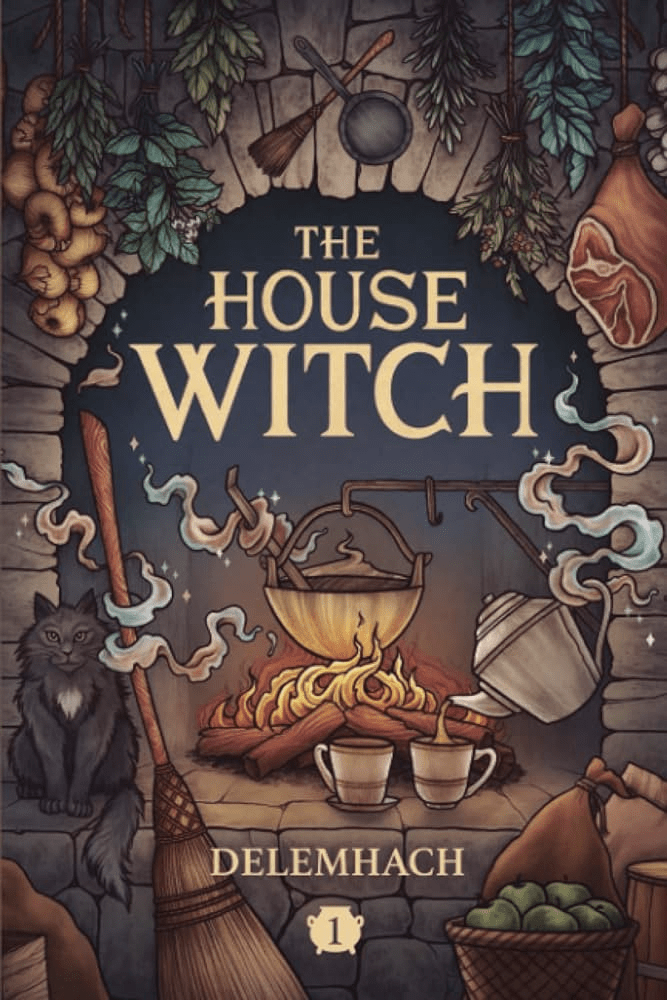
Finlay “Fin” Ashowen is the new head cook of the castle of Daxaria, serving the beloved king and queen and their court. However, Fin is a secret house witch, with abilities that revolve around keeping his home space clean, organized, and protected. Despite Fin’s best efforts, more and more people come to discover his magic, and he becomes entangled in several castle affairs, including protecting the pregnant queen and falling for Viscountess Annika Jenoure, who is not who she appears to be…
The first word people used when describing this book was “cozy.” Sure, I agree, a castle in a far-away land with kings and queens and PG-rated royal intrigue can be cozy. I guess they also meant “cozy” in that there are barely any stakes and the story unveils at a staggering pace. I mean, good Lord, the book is almost 500 pages long; you’d think a book of that length would pack a ton of story and worldbuilding.
Quite the opposite in fact.
I found myself only turning to this book when I was so creatively stuck and bored that anything was better than the silence of having done or read nothing. If anything, I probably could have listened to it at bedtime and dropped off to sleep to the droning nonsense of another passing adventure in the castle kitchen.
I’ve talked about books where there is little to no conflict, but the characters and worldbuilding still make it fun and even exciting at times. Here, there is conflict churning in the background with a war between Daxaria and its neighboring kingdom, but it features very little in the story, nearly to the point of irrelevance. Rather, we are treated to drinking contests, intrigues between bit-part characters, all the details of a single lady’s courting life, and it all adds up to very little.
In the hands of a strong writer, a book with a large cast can still be fun and engaging, but here, there were too many static players to keep track of. And again, despite the book’s length, the cast is not all that memorable or interesting. Sure, they have their backstories and such, but each character is squeezed so tight for space that they simply don’t leave an impact. Which is too bad because the narrative is third-person omniscient, jumping between character perspectives from paragraph to paragraph; I should know these characters really well and be more interested in their endeavors, but alas not.
I mean, for goodness sakes’, we have an entire backstory dedicated to Fin’s familiar cat, Kraken, getting involved with a gang of street cats. Even the cat needed to have their own set of dedicated chapters. That was probably the least interesting side plot in a book chock full of uninteresting side plots.
I think I’m also kind of disappointed in the story’s trajectory. There was a time where I hoped Fin would develop feelings for Hannah, one of his kitchen aids, who is very shy and afraid to stand up for herself. He comes to her defense so many times against a group of rowdy knights that I thought they would develop a sweet rapport, and eventually feelings. But instead, the rapport lies with Fin and a world-renowned beauty of a lady who is also a spy in the castle. I suppose it wouldn’t be a “proper” medieval romance without an average commoner and the world’s most drop-dead gorgeous lady, which maybe once I would have rabidly enjoyed, but it’s become a cliche that just doesn’t excite me anymore.
Perhaps I am merely projecting my wish for a story where the two romantic leads are of a more average nature, and where earth-staggering beauty has no part in it. Either way, the Fin-Annika slow-burn took WAY too long and it was not the pairing I was hoping for.
I guess it is nice that you don’t know what each chapter will bring, with the cast being so large. But the story feels unfocused enough that as time goes on, you care less and less about the stakes. That could also be because it took me three months to get through this book. And I get the feeling if I were to continue the series, which no doubt will increase its cast by at least ten characters per book, it will take me longer than I’d like.
I knew I was going to get something a little more relaxed and low-stakes with this book, but I did not expect it to be this slow. It was an interesting ride, I guess, as far as medieval fantasy stories go, but I think this series is a DNF for me.

 The Library Key