

Every reader knows the joy of going to used book stores. Or in my case, the Half-Price Books Mega Book Sale that occurs every fall in my area, where you can find books for dirt cheap. I’ve forgotten a large chunk of the books I bought at my first shopping spree, but one that sticks out clearly is Perfume: The Story of a Murderer. I picked this book up because I recalled seeing the trailer for the 2006 movie adaptation once. I just did not expect this period-piece mystery to turn into one of my most intense reading experiences of the last decade.
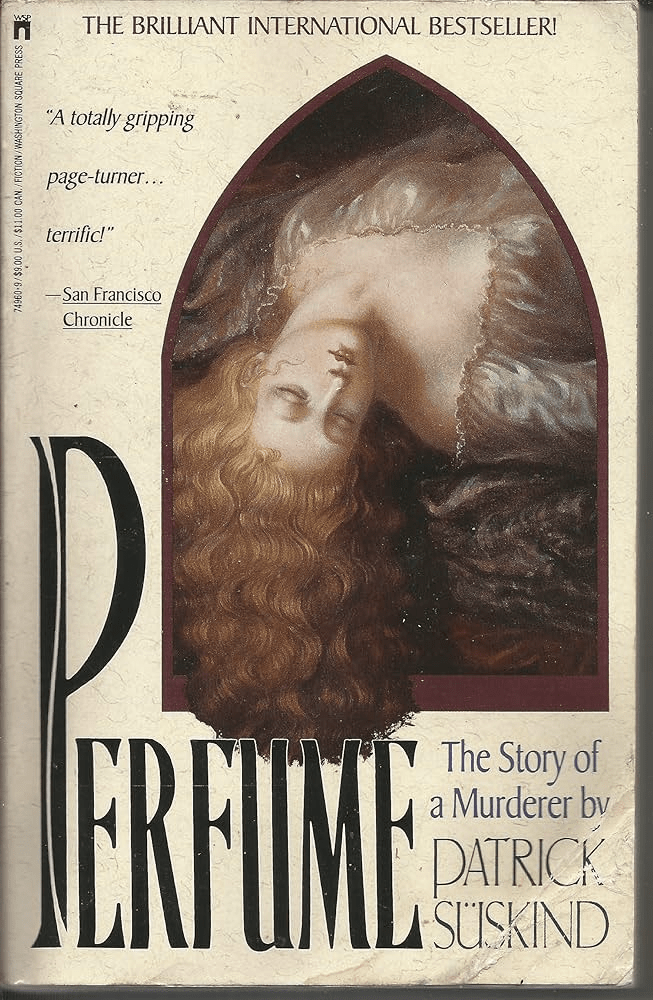
Jean-Baptiste Grenouille is an orphan in eighteenth-century France, born with an extraordinary, almost supernatural, sense of smell. One fateful night, his nose is drawn to the most beautiful scent he’s ever encountered, and he follows it to a young girl, sitting on a bench, peeling plums. Grenouille, in an effort to fully experience and possess the scent, accidentally kills the girl. He pursues the art of perfuming after the girl’s scent dissipates from her corpse, after which he slowly falls into depravity and murder, all in an attempt to create and possess the perfect scent…
This is one of those books where I broke bedtime and put off assignments many times to keep reading. I think of this book and I think of my bedroom in grad school, sitting on my bed, clutching the book, aching to see what would happen next, completely enthralled with the frenzied but remarkable writing.
Perfume is a bit of an episodic story, detailing significant events in Grenouille’s life, from his orphaning in boyhood, the murder of the girl peeling plums, his apprenticeship under an aging perfumer, to his mastering of smells and their unique power over people. It’s not just told from Grenouille’s point of view, but also from the people he meets as well.
For example, Grenouille approaches Giuseppe Baldini, a haughty perfumer well past his prime, about teaching him the art of perfumery. We get a lengthy look into Baldini’s sketchy backstory, before we get to see his sketchy treatment toward Grenouille. In the hands of a lesser author, Baldini’s backstory would come out of left field and we would be itching to return to Grenouille’s exploits. However, Baldini is immediately established as a bastard, and as soon as he meets Grenouille, we know that Baldini probably won’t be long for this world, given what we know about Grenouille and what we feel Baldini deserves as a liar and a cheater.
Grenouille also meets a marquis who wishes to pass off a stupid pseudoscientific theory on people, but he cannot do it without Grenouille’s perfume skills. Once again, an immoral, cheating prick who only takes Grenouille under his wing just so he can exploit him.
Believe it or not, Grenouille meets even more disgusting people on his travels, but I’d rather not spoil too much more of it. I’ll simply say that Grenouille happens upon a person who could give Judge Claude Frollo a run for his perverted money.
Grenouille is truly one of the most intriguing protagonists I’ve ever encountered. I don’t remember exactly how he’s described at the start, but I kept picturing a Mr. Hyde kind of figure, where he’s not really hideous, but you can just feel something is off about him. The most we can gather is that he has no human scent of his own, which, according to Grenouille, is why people stay away from him and therefore why he does not know love or friendship. Grenouille does not see beauty in the world through his eyes, but through his nose, so he does not want the plum-peeling girl for her beauty, but for her scent.
Not only does Grenouille possess a remarkable sense of smell, but seeming extraordinary intelligence as well. He learns quickly and adapts the methods that people teach him to suit his own great desire, which is to capture a scent that would make people feel love and adoration toward him when he wore it. It’s a very human thing to want, and it’s that small bit of painful human wanting that makes Grenouille so compelling, despite the vile things he does. He both hates humanity, but wants to conquer it; he wants to find love and connection, but also get the better of his wrongdoers.
The whole story feels like a fairy tale or legend. There’s too many wild coincidences and crazy occurrences, like a character conveniently getting killed off-page after too many immoral deeds, or simply that Grenouille has an almost magical sense of smell, and the effects of his perfumes are like magic spells. Not to mention that most of the characters are morally black and white, and their appearances reflect that, with the good characters being beautiful and the bad characters being ugly.
The scope also helps with this, since we go all over France, from Paris, to Grasse, to Montpellier. So much time passes in each location, with Grenouille doing many things to further his skills and grow his contempt for humanity, but it never feels rushed. Despite that Grenouille spends seven years in a single location, the story doesn’t drag, thanks in huge part to the unusual revelation Grenouille has there. That realization is so strange that it requires retrospection and explanation for the audience to understand it, which is all so eloquently written.
I must give credit to both Patrick Suskind and his English translator John E. Woods, because this is truly some of the best command of language I’ve ever read. In the time between this reading and my first, I never forgot how well the language engaged me, building up the experience of smelling a perfume or watching Grenouille’s perfumes work their magic.
Perfume does such a superb job combining visual with olfactory descriptions, drawing us deep into Grenouille’s world. I could recommend this book by the power of the language alone, but also for the sheer fairytale quality of Grenouille himself and his strange quest.

 The Library Key