

When I was in third grade, my teacher had a poster in our reading corner that featured a child’s hand reaching out to touch a floating fairy, with the title Fairy Tale: A True Story below them. I always wondered what that poster represented, but I didn’t find out until almost twenty years later that the poster was for a 1997 movie based on the Cottingley fairies of 1917. I’ve revisited Fairy Tale: A True Story a few times, and while it’s a perfectly forgettable movie, the true story it’s based on is hardly something to forget. After all, for a perfect moment in time, after two Yorkshire girls supposedly took a couple of photographs of fairies, a world wrought by war and disaster and grief believed in magic again.
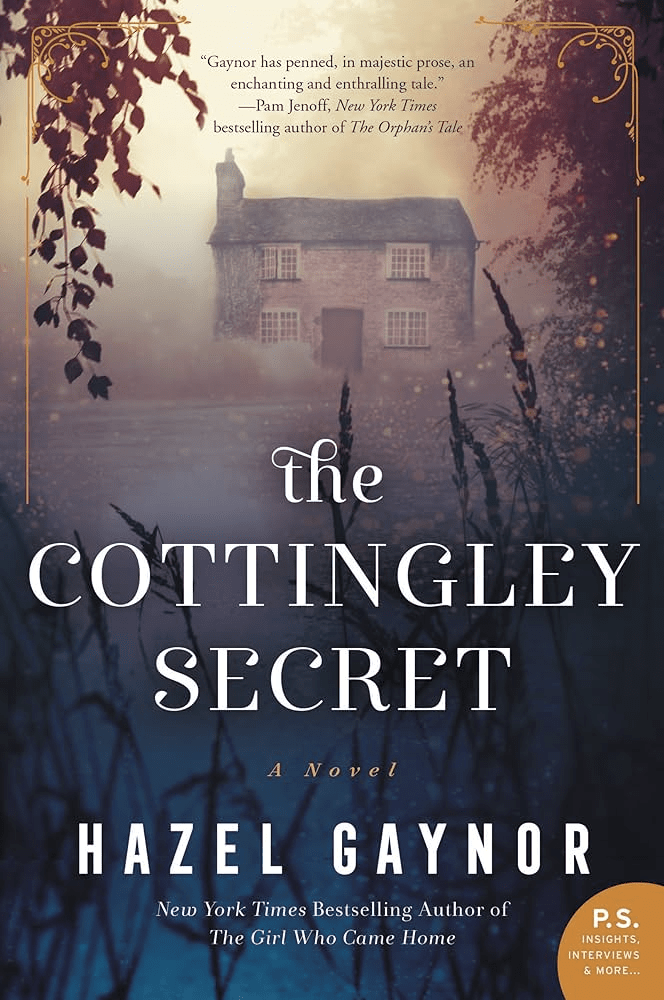
Olivia Cavanaugh has recently lost her beloved grandfather, but she’s inherited his Dublin bookstore. As much as Olivia loves the store, she is due to be married and move permanently to London. Among her grandfather’s papers is a memoir written by Frances Griffiths, who was only nine years old when she and her cousin Elsie Wright took photographs of themselves with fairies in 1917. Olivia reads the story of how the photos, meant only as a prank for Frances and Elsie’s parents, took the world by storm, sparking hope and joy in the middle of World War I. The further Olivia reads, the more secrets she uncovers about her family, and the more she begins to have a little faith in herself and her own choices…
I jumped on this book as soon as I read the synopsis, eager to see how the Cottingley fairies were handled. I myself had once thought of writing a story about the phenomenon, but I could only come up with what the movie did: that the fairies were real, and although everyone tried hard to find them, only Frances and Elsie could interact with them. Still, it is a sweet thought, that in the middle of the worst wars the world had seen, there was a glimmer of magic and beauty.
Frances’s memoir has a compelling voice. We are immediately on her side as a newcomer to Yorkshire from South Africa, whose father is fighting in the war, and who yearns for a little safety and normality again. The happy golden days she spends playing in the garden either with Elsie or the fairies is cute and the stakes feel pretty low.
Meanwhile, Olivia’s story shows her deciding which path in life she’ll take: whether she’ll marry her snooty, fancy-pants fiance, or if she’ll stay to run her grandfather’s bookstore. The answer is pretty obvious from the beginning, but the journey there is still cozy and satisfying.
I guess that’s one good word to describe this book: cozy. Frances and Elsie plan their fairy photographs and watch the world change around them, while Olivia gets used to running the shop and making friends with her regulars. There’s no true blue villain or deadline to meet: you just see these people getting used to their circumstances and adapting. It’s one of those stories that you can put on while you’re working or simply trying to relax.
It’s wild to think that so many experts and highly thought of people were influenced by the photos. Even Arthur Conan Doyle, creator of Sherlock Holmes, thoroughly believed in the photographed fairies. The best photography experts in London saw nothing fake about the fairies; one even said that he could clearly see the motion of their wings in the photo.
We in contemporary times might look at the photos and wonder how the heck none of these educated, highly thought-of people so quickly believed in the reality of fairies. Was the world really so starved for magic that it would even take these table scrap bits of “proof”?
Well, probably, yes.
Like I said, World War I was one of the worst modern wars, and almost everyone felt the effects of it, from seeing their loved ones going off to fight and not coming back, food rations, the fear of the right reaching the home, and so on. It must have been a difficult time when so many people were dying and it felt like the lights and lives of so many people were so brutally stolen.
And then, along comes these photos of girls playing and dancing with magical, beautiful creatures: creatures that according to folklore can guide and tend to the spirits of the dead. If it was possible these creatures existed, then there was some hope for all the poor souls who lost their lives in the war: that one day, everyone on earth would meet their deceased loved ones dancing with beautiful creatures in a circle of light and magic.
During hard times, everyone needs something to believe in, and during that time, people clung to the idea of spiritual beings such as fairies. If a little girl went missing, it was better to say she went off to play with the fairies, because saying she died was just too final, too grim, too dark. Far better to believe that your husband, uncle, brother, whoever, was guided to a better place by these gentle, magical creatures who would one day guide you to your own final resting place.
It’s not like Photoshop existed in 1917, either. And very few people would have been able to prove whether the fairies in the photos were real, so it was probably easier to believe maybe, just maybe, they were real.
Both Olivia and Frances’ stories revolve around having faith and trust. Olivia must learn to trust her own capabilities, while Frances witnesses what faith and trust can do for people in tough times. While both stories are pretty simple, I still enjoyed them both, though I do think I liked Frances’ just a little more.
If you’re going to write a book about the Cottingley fairies, it might as well be a cozy one. After all, it marks a time in history when the slightest touch of magic, even if faked, still made such a good impact on people. The photos have seen plenty of homages and recreations over the years, which I think still speaks to people’s fascination and love for them. I do feel bad that Frances carried the guilt about the photos being fake until just a few years before her death, but such an illusion feels no different than Santa Clause or the Tooth Fairy. There’s nothing wrong in believing in the spirits of such warm, magical figures, especially in a world so starved of joy, kindness, and safety.
Frances did maintain that, although the photos were fake, she did actually see fairies one day in the garden. Who knows if that is true or not, but if we cannot believe in a little magic from time to time, what can we believe in?

 The Library Key