

Very much like Beauty and the Beast, I think I have run out of ways to introduce a Nutcracker story. I cannot possibly describe any other way how much I love the story and how excited I am for every retelling to spin it. What really caught my eye about Hiddensee, however, was the subtitle: “A Tale of the Once and Future Nutcracker.” With that sentence alone, loaded with so much fantasy and whimsy, I knew I had to partake in this adventure or else regret it.
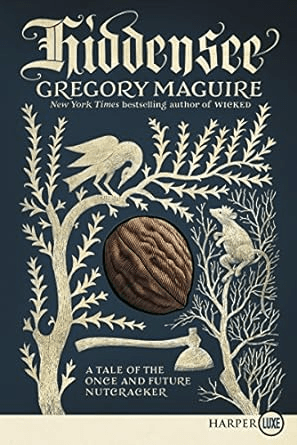
Dirk is a foundling raised in an isolated forest cabin by an unnamed old man and old woman. After a woodcutting accident, Dirk encounters two strange, magical beings before being sent back to the real world. Dirk decides to leave the forest and make his way into the world, where he meets several people who shape his existence, eventually taking the surname of Drosselmeier and learning to carve toys. But the magic forest follows him throughout his life, until his goddaughter Klara is born, which means he might have found the key to releasing that special place at last.
So many Nutcracker stories focus on Clara and her adventures in the snowy forest, but this is the first version I’ve read that focuses almost entirely on her godfather Drosselmeier. Drosselmeier is always cast as the mysterious magical mentor who shows up in some grand manner before granting the hero a magical item that kickstarts the adventure. Perhaps that means this book will give a little more insight and clarity into such a stick character, right?
Well, kind of, sort of, not really.
Because Dirk’s upbringing was so strange and disconnected from the real world, he has a hard time finding solid footing with people. He finds them odd and over the top and generally unreachable. He does manage to make friends and fall in love, but he remains stiff and kind of standoffish, keeping the enigmatic godfather in the same shadow as in the original story.
At one point, Dirk finds himself infatuated with his employer’s Persian wife, Nastaran. Nastaran is cold, distant, and the last person you would expect to become an object of affection. However, the reason for her suffering and coldness becomes apparent, and Dirk comes up with a pretty interesting way to attempt to save her, even if only in a symbolic way.
I wasn’t really a fan of how slowly the story unfurled. A good chunk of the story involves Dirk falling for Nastaran, wrestling with his lust for her, and discovering how he might save her from her affliction. But I do like the scenes where he talks with a doctor who proposes a supernatural component to not only Nastaran’s affliction, but also about what happened to Dirk after his childhood woodcutting accident.
Despite being surrounded by people who believe in magic and gods, Dirk remains firm in his nonbelief. But it’s only when magic can possibly save someone he loves that he allows himself to believe it. I wish I could describe it here because it’s quite beautiful, but I count that as spoilers. And the symbol itself is more beautiful and interesting than the actual characters.
Klara and the nutcracker do not appear until two-thirds the way through, and while I see why it took so long to get there, I wish they had come up sooner. And again, the idea of them is more interesting than the actual character execution. Klara tragically becomes a symbol for Dirk’s lost childhood and how, of all the children he has looked after, she is the only one that he comes to love and protect. She has an innocent, magical spark of imagination that her parents dismiss, but Drosselmeier tries hard to protect.
The nutcracker is the most beautiful symbol of the book. Drosselmeier finds that some people’s innocence has become locked away in golden walnuts, and the nutcracker helps them find it again by cracking the nut open. So it becomes easy to see why Drosselmeier winds up giving the nutcracker to Klara after he tried giving it to Nastaran.
This is only the second Gregory Maguire book I’ve read, but he has his own flavor of fairy tale. The magic is clearly there, but there’s sometimes a cynical, somber edge to it, like a Grimm story. Makes sense considering that this story takes place during the height of Brothers Grimm popularity. We don’t even know in this story if what happened between the Nutcracker and the Mouse King was real, or a fever dream of Klara’s, who is easily afflicted. But there is little to no pageantry, romance, or whimsy, which is why I enjoy the Nutcracker story so much; it wraps me up tight in all those things, appealing just right to the child in me without being saccharine. And what little whimsy there is here just didn’t satisfy me.
In the end, Hiddensee is a slow-burning and somber fairy tale. I won’t say that it’s my new favorite Nutcracker retelling, though it is rich in symbolism and has some inspired, if strange, writing in it. I think I much prefer stories that focus on Clara and the nutcracker, and I would have liked it if they appeared sooner here. What we have is not terrible, but it doesn’t quite add a new perspective to the story, there is very little of the Nutcracker flavor in it, and the ideas are more powerful than the actual characters.

 The Library Key