

I’m not sure I’ve read any post-1980s works of Stephen King’s. That sounds weird coming from someone who loves his stories, but I’ve heard so many mixed reviews of his more contemporary works that I guess I just don’t bother.
But I do remember when Fairy Tale came out. The cover, the title, and the summary were all intriguing, but despite how many times the book appeared on bookshelves, I put off picking it up.
However, last month, when I was at Half-Price Books selling some old tomes, I walked past the bestseller cases, and lo and behold, Fairy Tale was on display. And since I had sold some books for eight dollars, I figured I would knock eight dollars off Fairy Tale‘s price tag and take it home. I didn’t plan on getting into it right then, but the book called, as new books too often do, and I began reading…and could not put the book down.
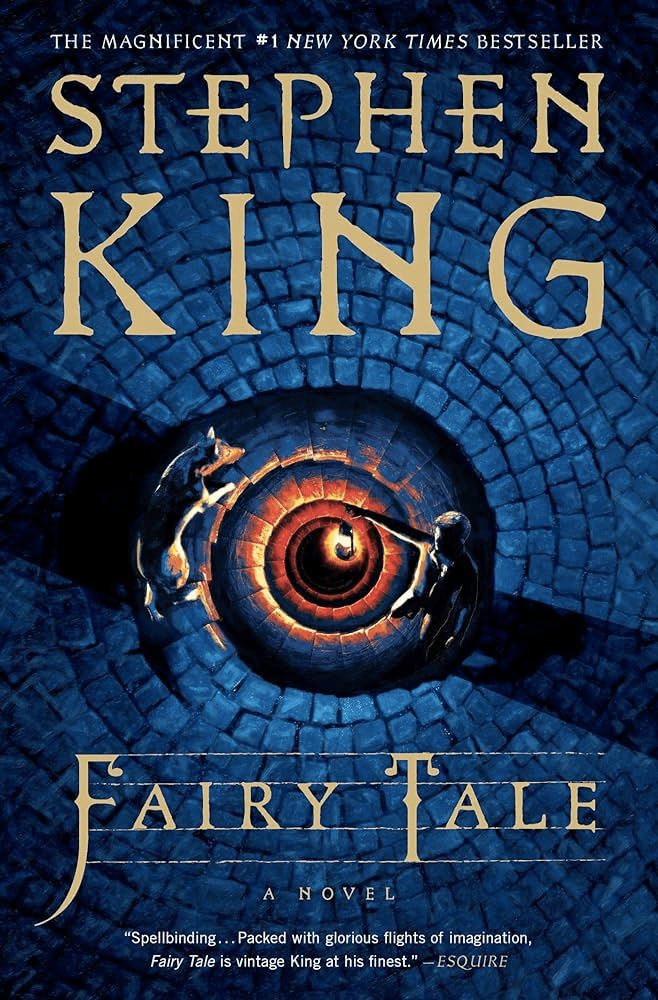
Seventeen-year-old Charlie Reade lives with his recovering alcoholic dad in Sentry, Illinois. Their neighbor is grouchy recluse Mr. Bowditch, who lives with his aging German Shepherd, Radar. When Mr. Bowditch gets injured and Charlie becomes a reluctant dogsitter, he soon comes to befriend and love both Mr. Bowditch and Radar. But after Mr. Bowditch passes away, he leaves Charlie a cassette tape that tells a terrifying, but still magical, story about what is hiding inside the old backyard shed, sending Charlie and Radar on an epic adventure through a whole new world…
I am not at all surprised by how much I enjoyed this book. King is a master at grabbing you from the first word and keeping you entangled in the story’s growing complexity. I am surprised though by how much exposition this book has and yet it remains entertaining.
Nearly the first fifty pages tells how Charlie lost his mother, his dad became an alcoholic, and became sober. All this is buildup to when the story actually begins: when Charlie meets Mr. Bowditch and Radar. Some might argue that the story doesn’t take off until Charlie learns about what’s in the shed, but that ignores all the story and character work that help make the cassette reveal so big.
As Charlie, Mr. Bowditch, and Radar become closer, it’s very slice-of-life, with not a whole lot of big things happening, but the characters are so richly drawn that you don’t really notice you’re watching the day-to-day. Watching Charlie grow close with the neighborhood recluse and his dog is just…nice, especially considering the tragedies that both Charlie and Mr. Bowditch have witnessed. Charlie is constantly worried about his dad relapsing, and Mr. Bowditch just wants his home and Radar to be safe. Both have something to lose, and they confide so well in each other.
But then, when Charlie hears the tape, and he enters the backyard shed for the first time, the tone shifts from slice-of-life to an epic, magical quest story.
Empis, the world under the shed, is vast and amazing. The size, scope, and the people and creatures living there are clearly fantastical, but they still have an element of horror. Once again, I am astounded at how well King can switch between genres; he dabbled in harlequin romance in parts of Misery, and now he shows his deftness at high fantasy with the second half of Fairy Tale.
I love how Empis is a world marked by Western fairy tales, with castles, magic, giants, kings, queens, princesses, and the like, but with a darker edge. It doesn’t go straight-up horror, but that’s what makes the world so appealing. There’s magic, but there are certainly things to be wary of, like in any classic fantasy. Yes, the sunset and sunrise are created with tremendous waves of flying monarch butterflies, but there are still giants and undead soldiers who will snatch you up and kill you. You could make friends with a kind, deformed woman who fixes old shoes, but you might wind up in a fight-to-the-death with people you call friends. For every bright, beautiful thing, there is something horrible to counter it.
It’s quite refreshing to watch Stephen King write moments of optimism, friendship, and hope in this high fantasy setting, and for me, they’re what keep this story strong. Charlie makes friends and they stick together through the horrors they endure in this large, beautiful, but uncaring world.
It is not a world where Cinderella, the frog prince, Thumbelina, and other specific fairy tale characters live, but they certainly feel inspired by them. Charlie meets a slimy con man named Christopher Polley who Charlie dubs his “Rumplestiltskin,” for how much he feels like the iconic fairy tale character. He also meets a pretty young lady who tends to the geese on a farm, dubbing her “the goose girl”, just like the fairy tale. And although Charlie points out that he is not Dorothy Gale and Radar is not Toto, one cannot help but draw the comparison anyway.
Like I said, the way this world comes to life, with Charlie learning its history and what must be done to restore it, is done wonderfully. His slow discovery of how the magic has been twisted and how he becomes entangled in the quest to restore it feels as epic as the world itself. That could be because the book is very long and you have plenty of time to get just as entangled as Charlie. But there is hardly a dull moment in the adventure, because you don’t always know where the fantasy will lead.
I like how Empis almost literally takes Charlie into its fold, translating both his and the Empisarians’ way of speaking to each other, and even changing his appearance to match the “prince that was promised” figure that will save the world. It somehow makes the magical world feel more alive and moves Charlie through his destiny.
Not gonna lie, the ending of this book evoked a lot of the same feelings as fantasies like The Wizard of Oz or The Return of the King, where the characters have completed their journey and they must say goodbye, but you don’t want them to. I had spent such a long time in this world and with these characters’ adventures that I dreaded the story ending.
That’s because Fairy Tale is a book that makes you feel like you’ve taken a journey. Like, a journey, where you can feel the time passing, the characters changing, and the sheer scope of the worlds they walk. Almost like by the time you’re done with the story, you’ve changed too, even if you don’t quite know how. And like I said, this book seemed to call in a way I cannot explain. But maybe that’s part of this book’s magic: it whispers and whispers until you give in to the call, and you’re pulled along on a journey like you haven’t experienced in a long time.
That basically puts Fairy Tale in the leagues of The Neverending Story, Wildwood Dancing, or The Light Between Worlds, where the worlds feel so all-encompassing and beautiful and the journeys inside so profound that, although you were just looking at words on a page, you feel like you’ve been changed too. It just further convinces me of the magic of books, and what treasures they will always be to me.
I wish I could go over every character, every adventure, and every moment of profoundly beautiful imagination, but I hope it’s clear by now that I consider this book a treasure: a tome full of the kind of magic that I always look for in stories.


 The Library Key