

Well, we’re diving back into the era of “classic” Stephen King with Christine. Many people seem to rank it among some of his best supernatural horror stories, alongside works like Pet Sematery or The Shining. I was personally skeptical about a possessed car actually being scary, but since King hasn’t failed me yet, I knew I would at least be pulled through the story even if I didn’t find it very scary. Honestly though, if I happen upon a 1958 Plymouth Fury after having read this book, I’m still more inclined to admire it than to be scared of it.
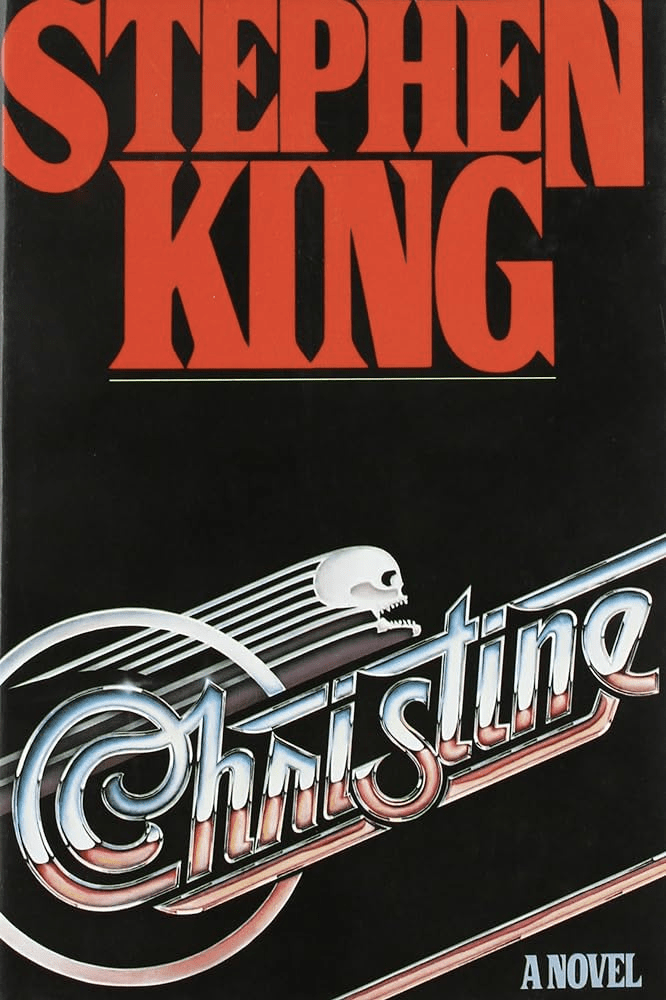
Teenage friends Dennis Gilder and Arnie Cunningham are driving one day, when Arnie spots a nearly-destroyed 1958 Plymouth Fury sitting in the front yard of a house. They stop to inquire about the car, owned by the mean and frankly scary Roland LeBay. Arnie manages to purchase the car, apparently named Christine, and takes it to a local garage to work on repairing it. As time passes, Arnie’s personality becomes aggressive and obsessive, forming an unhealthy attachment to Christine. Soon, anyone who messes with Christine starts to turn up dead, and Dennis and Arnie’s girlfriend Leigh try to figure out what is happening with their friend before someone else gets killed.
Frankly, it’s kind of silly to imagine being scared of a possessed object. Although I suppose if you’re going to attempt to make any mundane object scary, I would pick a car too. Christine as a car is pretty cool and her personality as a vengeful scorned lover of sorts is fun. I imagine this story appeals to people who give their cars names and personalities (mine is named Baby and she is the world’s most faithful traveling companion since Chitty Chitty Bang Bang, not that anyone cares).
But Christine may be the first Stephen King book that did not put my jaw on the floor.
Make no mistake, Christine is a well-put-together and compelling novel, just like all King’s rest. It’s just that a possessed car does not hit the same spot as, say, the psychopathy of Annie Wilkes in Misery or the striking psychological study of the trapped shoppers in The Mist. Every Stephen King work I’ve read has been entertaining, but Christine almost veers on the side of silly.
And maybe I should have known going in that a possessed car would be more of a popcorn monster than anything else: something to enjoy but maybe not really be too scared of. But I can’t help but be a little disappointed that the story did not scare me like it apparently scared a lot of other readers.
That said, I can’t be too disappointed in a story that gives its readers the space to figure out the horror behind Christine and Arnie’s personality change. And I guess there is something to be said for a horror story that leans just slightly into its silly premise and not taking itself too seriously. It’s not like the characters spout any proverbs or spell out any meaning to the story: it’s just a group of people having an unfortunate and random encounter with a supernatural object.
I do, however, think the antagonist of the story could have had a more direct role in the story and a motivation besides just being an irascible and angry individual.
Roland LeBay, Christine’s previous owner, passes away early in the story, and so a lot of his backstory is relayed to us through people who knew him. For all the talking that people do about him, you don’t feel like he has as tremendous and threatening a role as he could have. Maybe it’s because he’s dead and the only threat left is, well, a car, and it’s far easier, for me anyway, to be scared of a psychopathic man lurking around the corner than a car. But because that psychopathy is not shown firsthand enough, it doesn’t have quite the same punch.
That’s not to say that the book lacks any tension, of course. There is certainly a sense of dread about Christine and how Arnie changes for the worse after buying her. The gradual realization of how Christine and Arnie are connected, and the events that unfold around them both, is satisfying to watch, and the helplessness of everyone to stop it definitely racks up the tension.
The ending is really the only part where things get a touch silly. The buildup to what’s actually happening with Christine is way scarier than the actual reveal: as we realize what’s happening with Arnie and how unstoppable Christine may actually be. In typical Stephen King fashion, he always leaves a thread dangling, letting us know that although our heroes may have gotten away, they may never come out of the woods completely. It’s just depressing and dreadful enough for me without actually messing with the story’s overall satisfaction.
What keeps Christine from being completely satisfying is that there is no pure human element to it. The greatest Stephen King stories, I think, show a character going through a profound change or want something that everyone can relate to. Misery shows Paul Sheldon coming to grips with his relationship to his writing and Carrie shows its main character’s desperate desire to fit in and be normal, both of which are compelling and make the reader examine their own experiences.
Christine does not hold up a mirror to its readers in that way. It’s one of those stories that is fun to experience the first time, but is not likely to draw me back for a cathartic emotional journey. The only character we truly become connected to is Arnie, mostly because he is the put-upon outsider whose connection to Christine changes him from a good-natured teacher’s pet to a humorless sociopath possessed by evil. His loneliness and yearning for connection is what makes him vulnerable to Christine’s influence with unfortunate consequences.
I am glad I finally experienced Christine, and it was a fun ride while it lasted. I respect the place it holds in Stephen King’s career and its stake in pop culture, but I likely will not return to it again the same way I’d return to his other work.


 The Library Key