

I’m not very good at keeping up with authors I like, mainly because I’m lazy and simply don’t engage on social media that much these days. I also enjoy the delightful surprise of just perusing bookshelves and seeing that an author has a release I didn’t know about. It’s happened before with finding new entries in Ashley Poston’s Once Upon a Con series, and it happened once again with Luanne G. Smith’s The Conjurer, the third book in her series about magical women living in 1920s France.
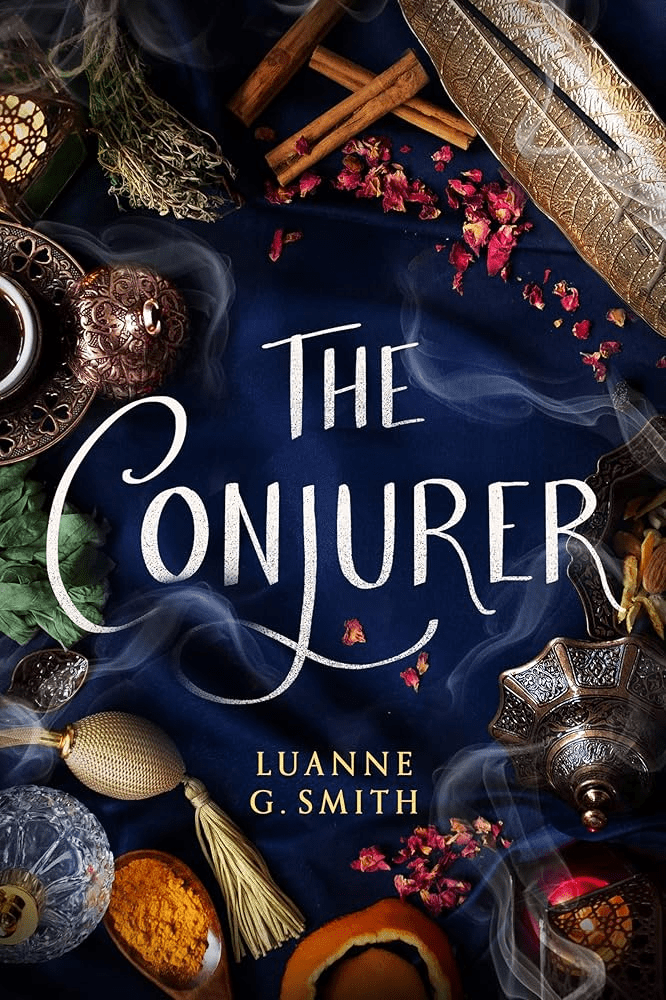
Sidra is a jinni, a magical spirit who lives in a bottle and grants the wishes of those who possess her three coin talismans. But now, she is fleeing from her brother-in-law Jamra, who believes that she murdered her husband Hariq. On the way, she forms a reluctant friendship with Yvonne, a fairy girl, and meets back up with Elena, a vine witch who she knew from their time together in prison. Together, the three women form a magical promise to stop Jamra from finding a magical dagger with the power to engulf the world in eternal darkness and destroy all mortals.
I knew I would enjoy this book from the first page. I mean, it’s the same world as The Vine Witch and The Glamourist, with plenty of cozy historical atmosphere and fun magic.
Sidra herself is another smart, capable heroine who remains one step ahead of her adversary, but still holds a healthy fear of him, as well as anyone who gets their hands on her talismans. Those who hold the talismans can make her grant their wishes, so she must keep them close. I like her, but Elena is still my favorite.
Elena has something to lose here too, since Jamra curses Elena’s husband Jean-Paul with a brain fever that could kill him. Luckily, her magic helps get her out of a few scrapes, but she has to think carefully and she tries not to let her fear show.
I’m learning more and more that a strong character actually shows a lot of fear. Yes, they need to be smart and capable, but it’s also important that they be afraid sometimes. They’re going through situations that a normal person would be terrified of, and if they don’t show some fear of that, it’s not very easy to relate to them. Much of the time, they’re improvising with what they have and just hoping everything works out, which in most fantastical situations, is the best anyone can do.
I enjoy Elena and the other witches more than the fairies and jinn because their magic feels true to real-life magical practice. Real-life witches rely heavily on their intuition to navigate their practices, and will often use tools like herbs as vessels for their magic. Elena often cannot create a magical result without something to work with, such as when she manipulates a glass of red wine’s properties to grow more potent to its consumer, or when she crumbles herbs into her palm and blows them away to create a brief wind storm. But beyond anything, she and other magical practitioners go off the rule that intention is the most important thing in working magic, which is, again, very true to real-life magic.
Plus, despite Elena’s extensive magical experience, she is still learning about the supernatural world. In fact, her magical education didn’t teach her a lot about the jinn, so Sidra has a lot to show her about that part of the world. And again, when dealing with Jamra’s shenanigans, Elena just does her best with her own magical knowledge. She does not have all the answers, but she at least has confidence in what she does know, which makes her capable but still vulnerable to mistakes.
The only hangup I really have is how complicated the story gets. Maybe there are plot points from way back in the first two books that I just forgot about, but there’s a whole miscommunication about why Sidra is blamed for her husband’s death, specific reasons for why Jamra’s revenge on mortals, what actually happened between the three, etc. It’s all explained in the end, but because the story was not the easiest to follow (or perhaps I’m an idiot), I didn’t care that much.
As a conclusion to a trilogy, the book works fine. We wrap up all loose ends, the characters have their happy endings, and there’s just enough of a spinoff without necessarily ending the story, which, I suppose, is all I can ask for. Despite some unnecessary plot complications, the book was still a compelling read with good characters and a world that is still as cozy and inviting as in the first two books. I much prefer The Vine Witch of the three for the romance, the witchcraft, and stellar world-building, so The Conjurer is far from my favorite. Still, it’s part of a larger story full of magical women who are strong, but still vulnerable, and smart, but still make mistakes. As the summary says, friendship is powerful magic, and I’ll stand by that true, if slightly corny, statement.

 The Library Key