

You probably wouldn’t know from this blog, but I actually consume horror stories quite often. I am subscribed to many a true crime YouTube channel, and I sometimes listen to Reddit stories about close encounters with scary people. I find them very mentally engaging when I’m waiting for the next penny to drop, caught in wondering how such deprived people exist, and constantly testing my limits about what I find horrifying. A Head Full of Ghosts didn’t test my limits, but it certainly reinforced why I find exorcism stories so compelling.
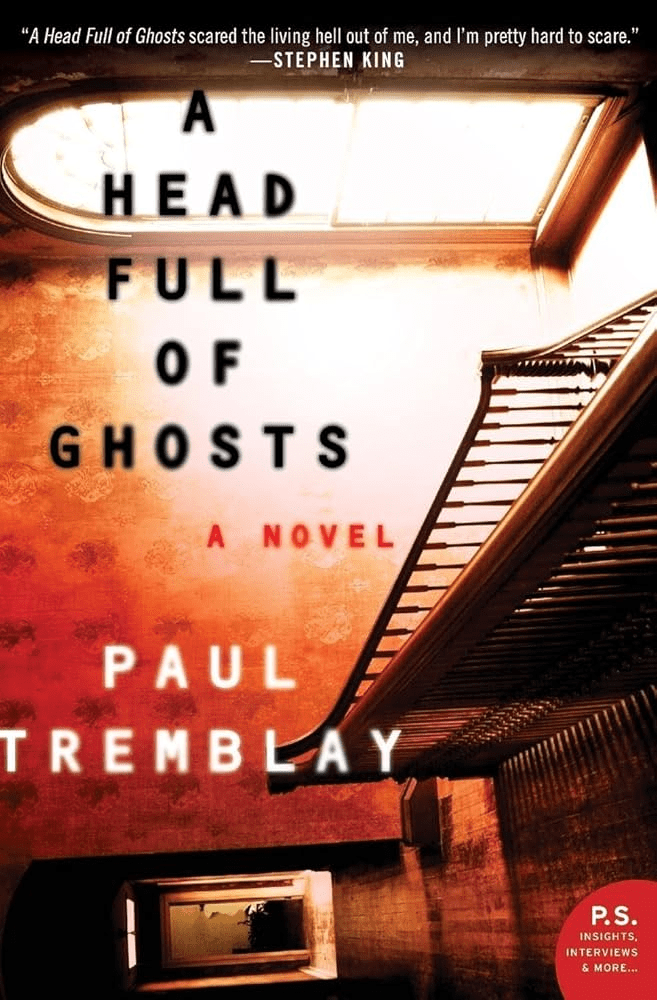
The Barrett family—father John, mother Sarah, and their daughters Marjorie, fourteen, and Merry, eight—are an average Boston family. Marjorie and Merry are as close as sisters can be, until Marjorie’s behavior turns strange and frightening. It becomes apparent that she is suffering from acute schizophrenia, but despite a diligent regimen of medication and doctor appointments, Marjorie’s behavior soon turns violent. Desperate, the Barrett family accepts an offer to be featured on the reality TV show, The Possession, which will tape the Barrett family up until the day that Marjorie will receive an exorcism. Merry, now a young woman, recounts her family’s horrifying experience and the truth behind her sister’s behavior.
Exorcism stories follow a very tight formula. If you’ve seen The Exorcist, then you have the blueprint for every good possession story out there. A Head Full of Ghosts falls into the same camp as these movies and their copycats, with the same compelling family drama and religious horror. It’s not quite as horrifying as The Exorcist, but it does tell a compelling story of a teenage girl’s mental illness being exploited for money, all while her little sister watches with horrified confusion.
The story is told from the perspective of Merry, Marjorie’s sister, who was eight years old when these events unfolded. In the present day, a twenty-three-year-old Merry has been approached by a kind writer who wants to tell Merry’s story as she remembers. The narrative splits between the writer’s finished book and her interviews with Merry, both of which provide clarification on a story that, thanks to the reality TV show the Barretts were featured in, has become an urban legend.
The exploitative nature of The Possession is truly disgusting. Although the adults try to give both Marjorie and Merry agency in this situation, you can’t forget why this whole thing is happening. The Barrett family agreed to be on the show because they were going broke from Marjorie’s medical bills and John’s inability to find work. Many people are skeptical about the exorcism working in the first place (apparently exorcisms cannot truly work unless all parties fervently believe that it can), and the producers seem more concerned with getting adequate show material more than actually helping Marjorie get better. The show actually winds up drawing attention from extreme religious groups who target and goad the family, which Merry suspects was instigated by the show’s producers.
There’s a real performative aspect even to the exorcism itself, with the crew decorating Marjorie’s bedroom with candelabras, white cloths, statues of the Virgin Mary, and crucifixes everywhere. They’re not preparing to help a real and vulnerable girl try to regain her senses, but rather dressing a set to perform something that could put that same girl in danger. It’s an idea of an exorcism rather than a real one, it feels like.
It’s crazy how quickly everyone gets caught up in the exorcism. Even when it seems like Marjorie has broken through and is genuinely asking for help, the priest, Father Wanderly, does not stop praying and stops her family from helping her. He is so caught up in religious fervor that he perhaps fails to see reason anymore. Same thing with the Barrett father, John. He has become so deeply lost in the religious weeds that he shouts prayers alongside Father Wanderly, forcing his family to pray with him every chance he gets.
But the whole experience is scariest and most confusing for Merry. She gets the sense that no one seems to know what to do about Marjorie, which would be a scary thing for a kid in an uncertain situation. She watches her parents lose their minds in one way or another, but to listen to her own sister tell her that she would cut her tongue out and then kill her and their parents is most horrifying of all. In a chilling scene, Marjorie rambles to Merry about the terrible ways she would physically harm her whole family, only to follow it up with a bright and bubbly “Just kidding.”
Imagine your closest family member saying that so callously, and then so lightheartedly, to your face. When you’re only eight years old.
I do like how this book doesn’t pretend like it’s breaking new ground on possession stories. In fact, a grownup Merry writes a series of blog posts where she watches the Possession episodes about her family, and breaks them down. She remarks about how Marjorie, if she were in fact faking her schizophrenia, would have taken cues from popular horror media, like The Exorcist. One could even argue that this book is a modern take on that story, since it can be hard to separate Marjorie’s “possession” from Regan MacNeil’s. But that doesn’t make the scenes where Marjorie acts out any less shocking.
But one thing that this book does really well is keeping you guessing the truth of the matter.
Marjorie lets it slip to Merry that she is faking her schizophrenia, something which she tells Merry not to slip to their parents. But she does some extraordinary things when confronted by Father Wanderly, so maybe she isn’t faking after all. And then, later on, when Merry is interviewed about one of Marjorie’s episodes, she reveals to the writer that she embellished a few details.
Okay, Merry, if you embellished that one part of Marjorie’s story, then what other parts might you also be embellishing?
Of course, Merry is telling this story fifteen years after the fact, with some of her memories meshed together with what she saw on the TV show. So the whole story is a giant mystery wrapped up in legend that took on a life of its own once with the TV show, and now again with the book.
I should have expected for this book to have a twist. I thought I had the ending in mind right from the beginning, but I think the ending I got was a lot more horrifying and heartbreaking. The conclusion that Merry draws about her family is tragic and haunting, and while you’re glad that she’s found a healing outlet for her trauma, you can’t help the melancholy sense that, no matter how she grins and bears it, the story will forever haunt her.
This book also reinforces why domestic horror can be so compelling too: that the place where you expect to always be safe can also be the space for some of the worst experiences of your life. I can’t begin to imagine the horror of feeling unsafe in my own home, of sleeping in the same space as someone that threatened me harm or even death, as Marjorie does to Merry. The contrast between the Barrett house before and after the exorcism is haunting, with the house having become a decrepit site for ghost hunters and morbidly curious tourists. I know I’ve said that haunted house stories don’t always do it for me, but maybe I simply haven’t read enough like this one that digs deep under my skin.
Like I said, I’m not sure A Head Full of Ghosts will haunt me the same way The Exorcist will, but it seems unfair to keep comparing these books as if they don’t play in the same field. This book is the Exorcist of the reality TV era, and it’s about as compelling a 2000s Exorcist story as you can get.

 The Library Key