

Back when I reviewed Rosemary’s Baby, I lamented that my Women’s Studies class did not study it alongside Ira Levin’s other iconic work The Stepford Wives. Rosemary’s Baby is an incredible piece of feminist fiction, but The Stepford Wives is so woven into pop culture that when someone hears the word “Stepford,” they instantly think of a place full of strange, sinister, inhuman individuals.
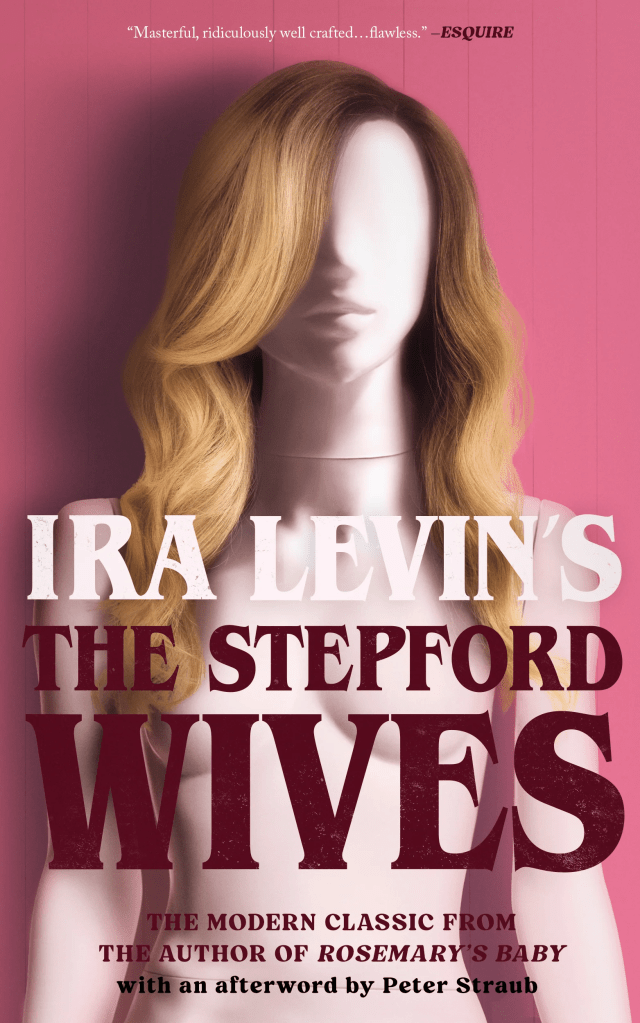
Joanna Eberhart, her husband Walter, and their two children leave New York to live in the quaint, quiet Connecticut town of Stepford. Joanna is a strong advocate of women’s liberation, a trait she does not share with many of her female neighbors, who would rather cook, clean, and keep house for their husbands. The few women that Joanna does make friends with change into perfect, submissive, smiling housewives overnight, making Joanna suspect something strange is going on. And it all comes back to the mysterious Men’s Association, where Stepford’s husbands, Walter among them, congregate to enact damning changes on the town…
This book is basically the Dr. Jekyll and Mr. Hyde of the twentieth century. Everyone more or less knows the twist about what’s going on with the titular wives. It’s a tightly written suspense story that cuts all the fat and moves at a brisk clip. In fact, the pace is so brisk that the story seems to celebrate how mundane and simple its setting is. All the mundane, everyday things the characters do reads almost like a laundry list, moving us through the story like a housewife moves through her to-do list.
Not only is the writing simple enough for a middle-schooler to get, but the message is near-impossible to miss as well. Of course, that comes down to how much Ira Levin satirizes the banality of the typical American housewife: only concerned with keeping a clean house for her husband and children. Whose biggest concern of the day is whether she will get the blue or pink soap at the grocery store. Who studies the instruction manuals of vacuum cleaners and steam irons to see which one will keep her house and husband’s shirts best. Distracted by insignificant decisions while the men do the “real” work.
The comparison between this bland archetype and Joanna is day and night: Joanna nurtures a freelance photography career and an ambition to open a National Organization of Women chapter in town, while the other housewives’ only ambition is pleasing their husband, with no personal autonomy at all. If her husband doesn’t want it, then of course she doesn’t want it either, because what good woman cares about anything beyond her dear husband’s needs, she asks with a doll-like, lifeless smile.
There’s a very subtly tense scene where Joanna drops her friend Bobbie’s child back after babysitting him. Whenever Dave, Bobbie’s husband, speaks to Joanna, Bobbie immediately follows up with something, and she only ever speaks after Dave does. Even when they’re the only ones speaking, Dave and Bobbie always have a dialogue tag attached to them, reminding the reader that they are speaking one after the other, as if in a synchronized, rehearsed tandem. The simple trick of showing the reader the back-and-forth of their dialogue is enough to instill a sense of dread, and it’s altogether a brilliantly executed scene. Really, this book is a masterclass in how just using simple language and small writing tricks can go a long way.
But that scene is a picture of the larger, more nefarious issue of the Stepford husbands.
Rather than risk losing control of their wives, these cunning and intelligent men would rather see them replaced with emotionless parodies of a real person whose only job is to gratify him. Women are not real people to these men, but objects built for sexual gratification and ego stroking: not a life partner with her own opinions and needs, but a mirror to reflect his greatness and manliness back at him. After all, the greatest accomplishment a man can boast is that he claimed a woman: that he fooled her into thinking he was a sensitive and caring partner, when all he wanted was arm candy and a submissive sexual partner.
It’s a tale as old as time: that the man is the hero and the woman is a simpering prize for him to claim after he exerts his manhood, either sexually or with another phallic object, usually a sword. And it’s because of this rather sexist tradition that we got women’s liberation movements: movements that Joanna wants to help spread among her fellow women.
Listen, if you are completely satisfied with housework and living to please your partner, then that’s fine. As long as your partner does not expect you to completely trade autonomy for it. It’s simply disturbing when a woman’s choice about what happens to her body is stolen from her, and it becomes the man’s choice instead.
The point is that women are people too, and we cannot expect for them to give up their rights to their bodies when they are, contrary to some disgusting people’s beliefs, perfectly capable of deciding for themselves what happens to their bodies.
Let me say it louder for the people in the back. Women are people too. And if you think that it’s up to you to lawfully decide what any person, man or woman, cannot do with their bodies, then you need to learn to mind your own goddamn business.
For all you know, a woman may request an abortion because her pregnancy is becoming dangerous and terminating it is the only way to save her damn life. It’s not about “selfishly” killing fetuses: it’s about saving the life of a living, breathing woman who deserves the right to her own decision and her own damn body. Women don’t just take birth control so they can have sex whenever they want: they take it to help regulate their menstrual cycles and help with family planning.
Yes, abortions and birth control help allow a woman sexual and reproductive freedom, but they can also help keep a woman alive and healthy.
It’s all about choice! Freedom! Taking these things away puts women in danger, and I cannot believe that people have to keep arguing this point.
Unless a woman gives you informed consent, it is not your choice what you do with her body. Call her a bitch if you want, but do you know what bitches have? Teeth. And believe me, when provoked enough, those teeth will come out with more strength than you ever dared to imagine.
Let me remind everyone again: the point of feminism is not to say that women are above men or that all men suck, but rather that men and women deserve to be equal. Therefore, the same way that men have every right to decide what happens to their bodies, so do women. The Stepford Wives, as feminist fiction, therefore serves to point out the ways that society mistreats women and denies them equality. The message is never that all men are terrible misogynists whose selfish gratification is more important than a woman’s life and autonomy, but that antiquated, dangerous views of women still persist and we should continue to challenge and correct these views.
The Stepford Wives may be satire, but it hits too close to home picturing men being so callous and unempathetic about women’s autonomy. It’s little wonder it’s become such a staple of feminist fiction.

 The Library Key