

Welcome to another edition of “Book that Stephanie Liked a Lot as a Kid But Did not Fully Appreciate Until Adulthood.” And this time, we’re covering the children’s classic Holes.
Holes appeared in me and my sisters’ classroom libraries when the 2003 Disney movie adaptation came out. All three of us read it, and consequently, we really enjoyed the movie when it played on the Disney Channel. I think we all could tell it was a very different, original, and mature story than what we normally consumed. Despite the fact that the book revolved around a group of boys in a juvenile detention center, the story was compelling and challenged us in ways we eight to ten-year-old children could handle.
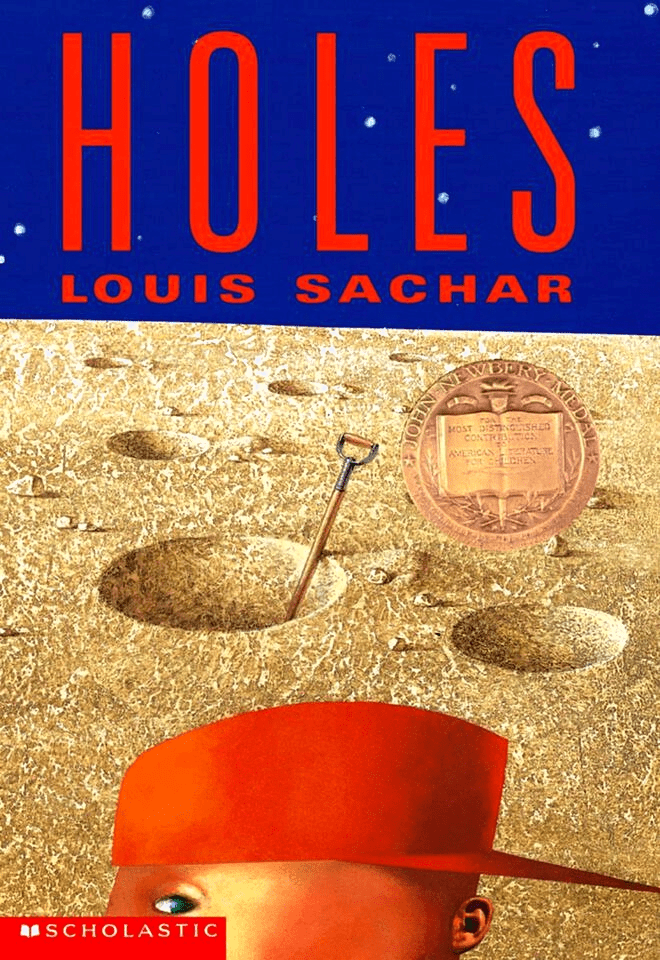
Stanley Yelnats IV’s family is believed to be under a curse. His great-great grandfather broke a promise to a vaguely magical Egyptian woman, and since then, the Yelnats have had the world’s worst luck. That bad luck gets Stanley a wrongful theft conviction, and he is sentenced to eighteen months at Camp Green Lake, an isolated juvenile detention camp in the middle of a dried-up lake bed. At the camp, the inmates must dig one five-by-five foot hole each day. As Stanley’s sentence goes on one day, and one hole, at a time, he begins to uncover a mystery that ties him to the inmates and counselors of the camp.
There are many things I never fully realized about Holes, starting with the fact that it’s basically a modern fairy tale. Stanley’s family is under a curse that started when an ancestor tried to prove his worth to win a woman’s hand, but his own mistakes got him in trouble. There’s also a mysticism about Camp Green Lake and how it went from a thriving lakeside village to a desolate desert.
But Holes is about more than just a teenage boy’s adventure at a desert detention camp. The book jumps into the past throughout, showing us not only how the Yelnats family curse started, but also Green Lake and how its people’s prejudices sowed the seeds for its downfall.
All three storylines of Stanley, his great-great grandfather, and Green Lake are immensely compelling, particularly the Green Lake narrative.
The Yelnats family lore tells of how Stanley’s great-grandfather was robbed by an outlaw named Kissin’ Kate Barlow. Before she was an outlaw, she lived in Green Lake as a schoolteacher who fell in love with a black onion farmer named Sam. This being the 1880s in Texas, naturally, it was against the law for them to be together. Kate’s story devolves quickly into tragedy, and hosts a few of the book’s darker scenes.
For example, Kate’s affection for the black Sam pisses off the town bully, Trout Walker, and he riles up a mob to set Kate’s schoolhouse on fire as revenge. When Kate runs to tell the sheriff about the schoolhouse, she discovers that he’s drunk. He tells her he always gets drunk before a hanging, much to Kate’s horror; Sam, a black man, is due to be hanged for kissing her, a white woman. Kate vehemently declares that everyone is equal under God, to which the sheriff replies, “Well, if Sam and I are equal, I want you to kiss me.”
I had to pause. I knew this story went hard in the darkness, but I forgot how truly hard it went sometimes. If only because it makes you reflect on the long, hard road that we’ve walked with racism.
In 1880s Texas, or anywhere really, a black person could be the kindest, most thoughtful and helpful person in town, but the mere fact that they had dark skin opened up horrifying possibilities for them. Despite Sam’s positive and loving reputation as a handyman and healer, he broke one simple rule, and the entire town turned against him and Kate overnight.
Kate’s story is tragic and haunting, and would probably be my favorite part of the book if not for one character in Stanley’s story. And that character is Zero.
Zero is the smallest inmate at Camp Green Lake, who Stanley becomes close to when he teaches him to read and write. Zero is illiterate because he grew up without a stable home, with his mother abandoning him at a park. He tells an incredibly sad story about waiting for his mother at the park, where a birthday party was being held. The kids kindly offered him to play with them and have cake, but then the adults interfered and rejected Zero, leaving him with no friends and no cake.
I had to stop reading right then and there so I could sob for poor little Zero. There’s something immensely heartbreaking about a lonely child looking for connection, and getting within a hairbreadth of it, only for it to be taken brutally from them. And it truly speaks to the innocence of children offering each other friendship, only for the grownups’ prejudices and fears to ruin everything.
Plus, the way that Zero’s history ties in with the camp, and even Stanley himself, blew my mind as a kid. These three stories are not only compelling by themselves, but they weave together quite seamlessly. It’s definitely an early memory of seeing the puzzle pieces fit and being in total awe of it.
Zero is one of a group of kids dealing with a dangerous power imbalance. He dealt with it when he and his mom were homeless, while the other Camp Green Lake inmates deal with counselors who control their water intake in a vast and dangerous desert. Loneliness, despair, and even death are constant companions for these kids. These boys are young teenagers, and yet they have to at one point consider whether they’ll have to dig a grave for one of them.
It’s wild how many of these heavy-hitting themes I took for granted as a kid. I knew this was a dark and challenging story, but maybe that’s the power of it. It stays with you and then you begin to really sit with the deeper themes and lessons, and it just becomes more powerful.
It’s not hard to understand why Holes won the National Book Award in 1998. Its themes, original story, and characters are hard to forget, and they are told very tactfully, so that both children and adults can engage with them. I hope future generations continue to enjoy and appreciate it, and, for good measure, watch the movie after.


 The Library Key