

I try not to hop on bandwagons, but I could not help myself. The Wicked movie, based on the acclaimed Broadway musical, based on Gregory Maguire’s 1995 novel, captured my imagination unlike any movie I’ve seen in forever. If Elphaba and Glinda were icons before this movie, they have been absolutely cemented into pop culture for decades to come. And so, I decided to give the book another try, if only to remain within the enchanting, but deeply flawed, land of Oz with one of the world’s best-known witches.
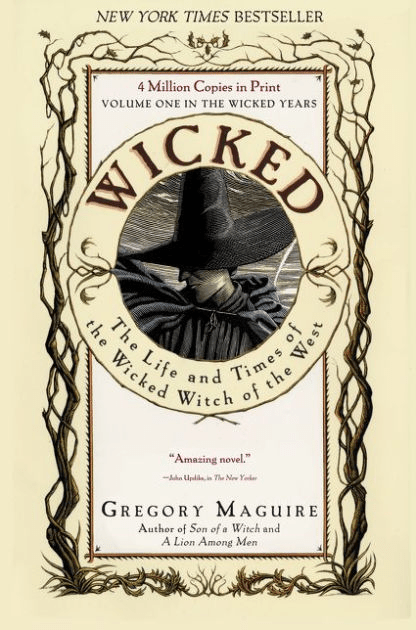
Elphaba Thropp was born a monster, with green skin, sharp teeth, and a vicious personality. She grows up in Munchkinland before she goes off to Shiz University, where she is forced to room with Galinda (later Glinda) Upland, a vain girl from Gillikin Country. There, Elphaba becomes friends with Galinda, but she soon learns of growing political unrest in Oz, particularly of the Wizard’s new laws about Animal rights. Elphaba tries to plead with the Wizard not to take away Animal rights, but their encounter sows the seed for Elphaba’s fated reputation as the Wicked Witch of the West…
I first tried reading this book back in college, since my roommate (who is the Glinda to my Elphaba, although she might claim the opposite) absolutely adores the Wicked book series. In fact, she wrote her college thesis about the book, she loves it that much. Unfortunately, I learned very quickly that Gregory Maguire was an acquired taste, so I didn’t even make it past the first chapter. Now I’ve read a few of his books since then, so I knew what to expect with Wicked.
Gosh, I wish I had kept going that first time. Because this time, I was pulled so hard and fast through the story I was halfway through before I knew it.
Give Gregory Maguire some credit, he is good at moving his characters through time. We see just a few key events in Elphaba’s life before the story fast forwards a few years at a time. But the time jumps are not jarring. We can only spend so much time in Elphaba’s childhood before we have to meet Glinda, Fiyero, Boq, and all the other key players in Elphaba’s transformation from spitfire student to underground revolutionary.
What’s also enjoyable about Wicked is how not a lot of explanation is needed for the time jumps. We can infer very quickly where the characters are now, what has happened since the last chapter. For example, a time jump introduces the readers to a chapel where Saint Glinda is the patron saint, and you can infer that since Elphaba left everything behind to help the Animals, that Glinda has become a public figure and is revered to the point of sainthood. We don’t need to see how that happened: we just see Glinda in her new life with little explanation. Filling in little blanks like that keep things moving without getting bogged down with too much backstory.
It was surprisingly easy to separate the book from the musical in my head, because they are so, so different from each other. I can see, though, why the musical went the route it did, because a book with this much story and character would require condensing for a wider audience to enjoy. A child could enjoy and understand the musical, but the book, with its themes of religious fanaticism, political unrest, death, adultery, and abandonment, is very much meant for adults.
What surprised me was how little magic featured in Elphaba’s life until after she left Shiz. There is no grand show of magic skill, unlike in the musical, where Elphaba’s talent is what inspires her to “make good”. The focus seems more on how Elphaba’s political attitudes affect her ability to keep her friends and be anything but a public monster. She wants to help those whose rights are unfairly stripped, but she must do it outside the law. The only show of magical skill she really has is flying her broom, although it is implied that the broom is previously enchanted, and could fly without any magical influence from Elphaba.
In fact, her title of “witch” is more a propaganda move than an indicator of true magical talent. After her dismal failure to convince the Wizard to give up his march toward fascism, she becomes known throughout Oz as a witch and assassin. But Elphaba embraces the title, since as she says, if you’re going to be known as a lunatic, why not get the benefit of being freed from convention?
The idea of news spreading and narratives changing among different religious and political groups in Oz is fascinating, because Elphaba is not the only one saddled with multiple names and public speculation. When Dorothy arrives and starts her journey to the Emerald City, people speculate as to whether she is an enchantress or even if she is the reincarnation of Oz’s true ruler come to overthrow the Wizard.
The worldbuilding of this book is extraordinary. Multiple religious and political parties speculate about the origins of Oz and the Wizard’s plans for Oz, and again, it’s not just dumped into the audience’s lap. It happens piece by piece, allowing the reader to place the pieces of Maguire’s Oz together, truly breathing new life into such a familiar world.
But like I said, this Oz is steeped in political turmoil, with the Wizard declaring himself the Emperor Wizard, installing soldier groups throughout the land, creating indoctrination camps for Oz’s children, and trying to pull every annexed piece of Oz back into his power as he can. Elphaba is absolutely aghast at how so many people are willing to sit by and let the Wizard’s power go unchecked. And despite how she tries to stand up to him, or how many ways she tries to gather people behind her, Elphaba is unsuccessful.
Aside from standing against the Wizard’s tyranny, much of Elphaba’s motivation stems from trying to find forgiveness for a tragedy that occurred after she abandoned her friends at Shiz. But everyone is in such denial about the tragedy that being able to receive forgiveness for her part in it eats her up.
What’s worse is that, at one point, Elphaba allows herself hope that the person she lost has come back somehow in disguise. But once that hope is dashed, it absolutely devastates her.
I love how we get much more nuanced interactions between Dorothy and Elphaba. And you can’t help thinking the whole time what tragedy will come when Dorothy inevitably tosses the bucket of water onto her.
Let us not forget that this is a grim book on the whole. Oz marches ever faster toward a totalitarian regime, Elphaba’s friends vanish from her life one by one, and her attempts to keep those she actually loves safe are unsuccessful. When Elphaba says she’s going to disappear into a cave and bury herself alone in the darkness, you can’t blame her.
As much as I enjoyed this book, I’m not sure I’m going to leap into the rest of the series. Gregory Maguire noted in an afterword that he partially wrote the other books to cope with a post-9/11 world, and while I’m sure they’re good books, I’m ready to tackle a book with such heavy themes.
I honestly expected to go into this book worrying that I would give it up a second time. At the end of the day, I’m very impressed with the worldbuilding and glad that it swept me through to the end.

 The Library Key