

You all know by now of my love (okay, perhaps obsession at this point) with witch books, but The Witch Haven presented a new historical angle to this obsession. The book takes place in 1911 New York City, with a summary that promised mystery, underground societies, and magical sisterhood. So of course I was going to pick it up.
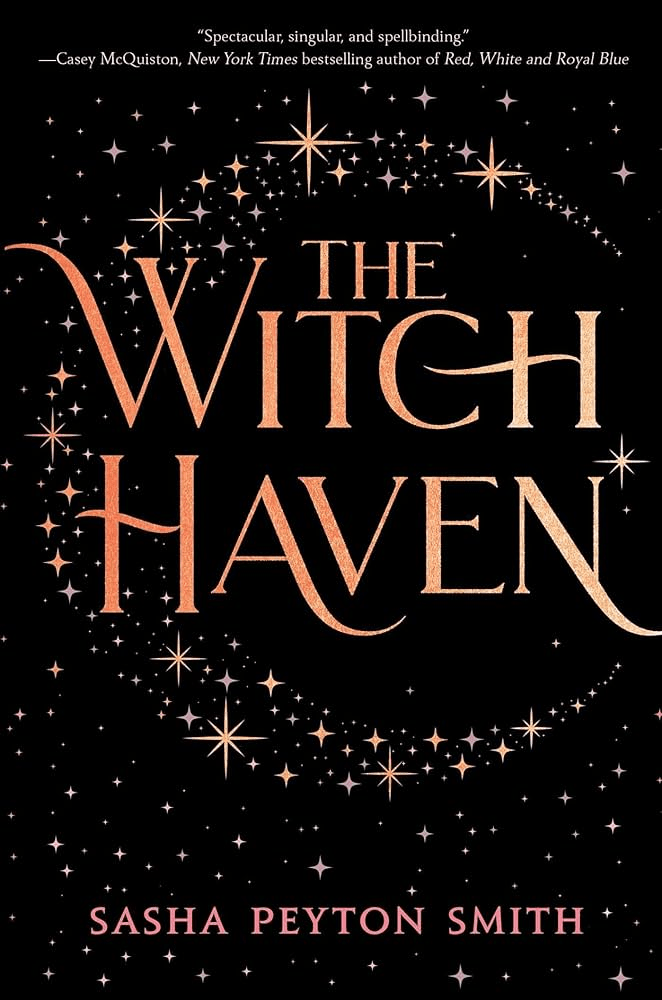
Frances Hallowell’s life is close to shambles: her mother has gone mad, her brother has been murdered, and she works as a seamstress under an oily manager. But when she is forced to defend herself from said manager, she discovers she has magical abilities and must now train as a witch. Frances is sent to live at Haxahaven Academy, where she’ll train with other young witches. But as Frances learns more about the magical world, she discovers there may be a way to solve her brother’s murder and get justice against his killers, leading her into the seedy magical underbelly of New York City.
It’s easy to see why I was taken with this book, starting of course with the witches. But a little known fact is that I’m fascinated with 1900s America. It might have been because I had a Samantha Parkington doll from American Girl, and her story takes place in 1904 New York, so I learned a lot about that time period through her books. I’m no expert, of course, but the fashion, politics, social expectations, and overall atmosphere of the period is quite interesting nonetheless.
Frances is an easy protagonist to relate to. What she wants most is to solve her brother’s murder and believe that she has a future outside of being a low-income seamstress. I like how even though she learns a lot about magic, she is still very cautious and even afraid of it. A whole other world has opened up for her, and she’s sensible enough to not dive headfirst into what she doesn’t understand.
In fact, although she is determined to solve her brother’s murder, she remains scared and vulnerable through it all. After all, she is dealing with people more magically and politically powerful than her, and one wrong move could ruin her chances of success. Make no mistake, Frances is capable when she has to be, but she still asks for help and gives in to despair and disappointment.
I just find it so refreshing how Frances learns and grows but always feels vulnerable and relies a lot on her friends to help her. Maybe I’ve listened to too many people complain about the girlboss trope and so I’m extra sensitive to whether a character fits that criteria, and Frances most certainly does not.
The one thing I couldn’t care less about is the romance, which is a given of course, but still kind of unnecessary.
Frances meets a boy named Finn who can walk through dreamscapes. Many years prior to the story, he started having dreams about Frances, and he has been waiting to meet her in person. After Finn and Frances meet, he allows her and some of her Haxahaven friends to learn advanced magic from him, and over time, they develop a liking.
I won’t lie, I rolled my eyes when Finn said he knew Frances from his dreams, and he’s been waiting to meet her. It feels like such a sentimental wish fulfillment trope that it might have put me off the potential romance instantly.
In order to cast one important spell, Finn and Frances perform a bonding ceremony to combine their powers and make the spell work. It’s basically these two older teenegers getting married despite only knowing each other for a few months, and Finn is confident that this bond will last after the story is over. Like, dude, you took her on one date to Coney Island, helped her cover up a murder, and sneak in and out of a gentleman’s club. I hardly think that counts as a basis for a stable, lasting magical marriage.
The book didn’t lose me at that point, but that part of Frances and Finn’s “relationship” really did not do it for me.
This book does not shy away from the more heartbreaking aspects of 1900s New York society. Haxahaven is home to young witches of all races, and the school pays stipends to these colored girls’ families, provided they behave. One of these girls is Lena, a Native American girl who becomes Frances’ best friend at the school. She describes how she discovered her magic when she was defending herself from a racist teacher, talking of how members of her tribe were abused and killed. Lena and other colored girls are targeted at Haxahaven, with their bullies knowing full well the extent of their disadvantages.
And even though these girls are learning magic, they do so cautiously, learning to do small spells that help with household chores. So even with all this magical potential, they’re basically learning to be superwomen, with little ambition beyond the household. It’s this boredom that drives Frances and her friends to seek out Finn and his lessons.
Although we don’t get to know the other Haxahaven girls as well, I do like their camaraderie and sisterhood as witches. When all seems lost, they step up beside Frances to fight together. It’s always a wonderful thing to see women banding together in the face of adversity, and I’ll never stop singing the praises of that witch story trope. And boy do these girls have some nasty enemies to contend with.
The villains in this book are disgusting in their drive to control others, mostly in the name of revenge. People are getting killed because of them, and they don’t care who they have to dispose of to get what they want, planning their evil schemes well before the main characters realize they are pawns.
I was not expecting for this book to have a twist villain, though. You’d think watching most of Disney’s recent movie releases would have trained me to watch for one, but I was so wrapped up in the story I forgot to think about where exactly it was going. All this book’s villains are terrible, but this one is the most devious and awful and empty-hearted of them all, who is obsessed and entitled and cannot understand why their worldview is so insane.
For a time, it does feel like there are too many pieces of unresolved plot floating around. But I promise everything comes together in the end, although it does leave room open for a sequel. And this time, I might actually have to keep my eye out for it, because the cliffhanger is so tantalizingly disgusting and bizarre that I need to find out what happens next.
If you’re looking for a bit of a slow-burning murder mystery, I think you’ll like The Witch Haven. It doesn’t have too much in it for the history fans, which I was a little bit disappointed about, but the 1911 setting is a breath of fresh air. It has a likable heroine, and if there is a sequel, I look forward to learning more about her and her growing coven.

 The Library Key