

If there was a trifecta of books that my classmates and I read in elementary school, it was Roald Dahl’s Matilda, Charlie and the Chocolate Factory, and James and the Giant Peach. I suspect it was in part because we all had seen the movie versions of these stories and were familiar with them before we cracked open the spine. If you didn’t read all three, you at least read one of them.
James and the Giant Peach was probably the one I liked the least as a child. Which is not to say that I didn’t like the book. I watched our recorded-from-the-Disney-Channel copy of the movie many, many times, and I do remember fondly reading the book with my mom and sisters. But I can count on one hand all the times I have reread it, and it was long enough that I decided to crack it open again.
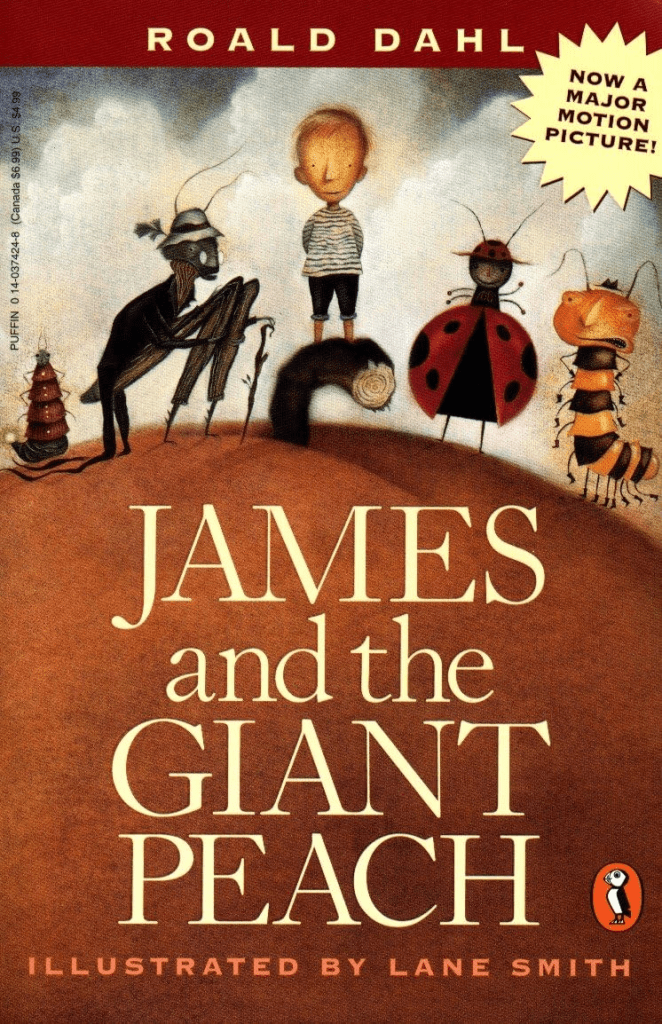
After James Henry Trotter loses his parents in a bizarre accident involving an angry rhino, he is forced to move in with his greedy and cruel Aunt Sponge and Aunt Spiker. James leads a miserable life with his aunts, until he meets an old man who gives him a bag of magic crocodile tongues that, when ingested, can solve all his miseries. But James accidentally spills the bag and the magic tongues worm their way into the garden, paving the way for a strange but magical adventure. And it all starts when the tree in the garden grows a giant peach…
This story has Roald Dahl written all over it, from the put-upon young protagonist to the sadistic adults to the peculiar creatures in the background. Compared to his other words, though, James and the Giant Peach feels surprisingly simple. Not only is it half the length of Matilda, but the story and characters feel a lot more childish and one-note.
This might be another case where the movie is better than the book. Hear me out.
In the book, James’ motivation is wanting to escape his miserable life and make friends. He realizes both these things the moment he meets the giant insects living in the peach, which is barely halfway through the book. In the movie, James wants to go to New York City, since it’s “the place where dreams come true”, per his parents’ description. It’s wanting to see this special place he would have visited with his parents that keeps him going across the ocean with his friends, who also seek safety and success in the city.
The book also feels more like a series of events than a fully cohesive story, probably because there is nothing driving the characters forward other than the peach itself. They ride the peach across the Atlantic Ocean using over five-hundred seagulls to carry it, but there is nothing that they’re necessarily heading toward. Adding the central motivation of getting to New York City makes the journey more compelling than just a random voyage across the ocean. A voyage that, honestly, should be more exciting than it is in the book.
If you were going to hear a story about a young boy crossing the Atlantic Ocean on a giant peach with larger-than-life insect companions, you would expect the usual trappings of an adventure story, such as encounters with dangerous monsters, long stretches of travel time, and compelling character development. For all the interesting obstacles and characters that James and his friends come across, the story feels like it ends before it can do anything really epic.
There are only two major events on the peach’s journey: an encounter with hungry sharks (which is how they decide to rope in the seagulls), and avoiding the wrath of strange cloud men building a rainbow in the sky. While both those scenes are full of action and humor, I think there could have been more of those to make the adventure feel more complete. Having more encounters like these could give the characters more to bond over and react to in different ways.
Whatever bonding time these characters do have is breaking into random songs and talking about how each insect contributes to the ecosystem. It’s fun how the Centipede’s song about his extensive culinary adventures made it from the page to the screen, but you feel as if the characters could have grown closer together in a different way here.
There are seven insect companions fighting for attention, and they don’t have enough time to fully flesh themselves out. We get the basics, but once again, I think the movie did better by taking out the Silkworm (who only assists in creating the silk loops to capture the seagulls and then disappears from the story) and scaling back the Glowworm. I’m not saying the movie versions are really much deeper, but there’s more space to play with their personalities and give each one a purpose when there are only five.
James himself feels kind of like a cipher: a person that the reader can attach themselves to so as to imagine that they are the hero. Which, for a children’s book, is not a bad thing. But he is generally just a kid that takes in the world around him without influencing it in any way. Yes, he is the one who discovers how they can use the seagulls to carry the peach, but he is not a very impactful hero.
It also made more sense in the movie to maintain a central antagonist. In the book, Sponge and Spiker are killed when the cut-free peach rolls over them, but they make a return at the end of the movie to bookend James’ arc into a more self-assured kid. It may be darker for them to be killed by the peach, but it’s more satisfying to see them humiliated at the hands of James and his insect friends.
But again, there is nothing really compelling these characters to journey across the ocean. And by the time we finish the journey, it just kind of fizzles out. Like, hooray that everyone got their happy ending, but what are we supposed to take away from this adventure?
Despite all these flaws, it is still difficult to dislike James and the Giant Peach. It is an iconic piece of children’s fiction, and it’s difficult to imagine anyone besides Roald Dahl, despite his own glaring flaws, coming up with a concept this bizarre and whimsical. As an adult, I think Matilda resonates a little better, but for a younger reader, James and the Giant Peach is not a bad introduction to the Roald Dahl universe. As for me, I’ll probably return to the movie version sooner than the book.

 The Library Key