

It’s a lofty temptation indeed when a whimsical book summary about an overworked adult’s childhood dreams coming true comes with literary award nominations. Although, even if The Wishing Game did not come with any accolades, it would have intrigued me enough to open it, because I am also an overworked adult who yearns for childhood whimsy. I guess I needed a lot more whimsy to ease my adult worries than this book could deliver.
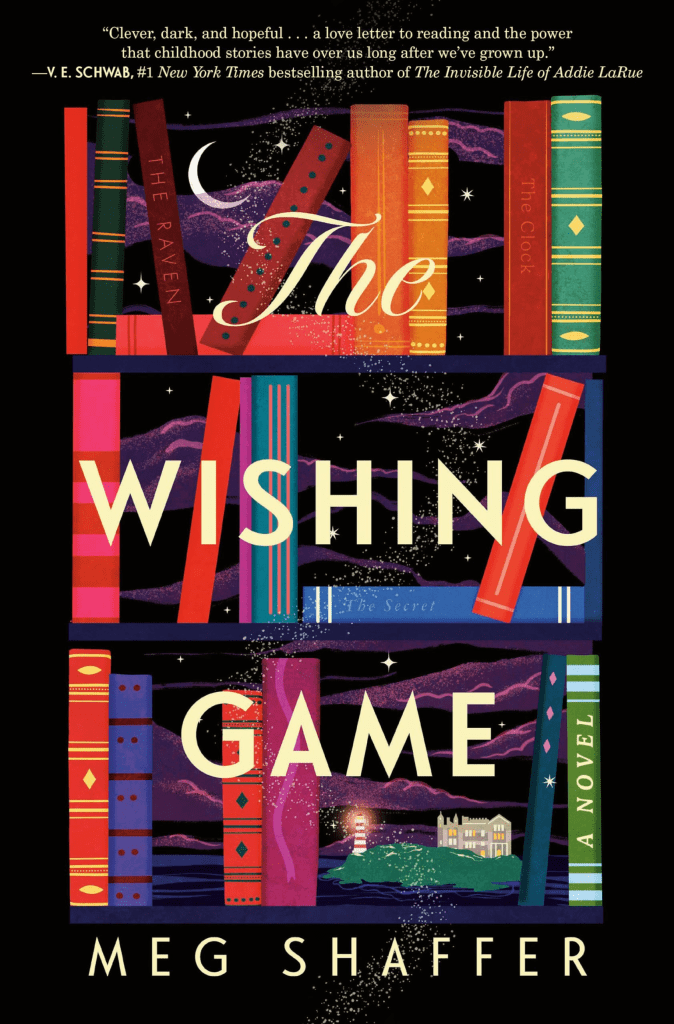
Lucy Hart is a lowly kindergarten teacher’s assistant, waiting for the day when she’ll be able to finally adopt Christopher Lamb, a foster child in her classroom. She and Christoper bonded over their mutual love of the Clock Island book series, which Lucy found solace in as a lonely, unloved child. But one day, a contest is announced in which one lucky winner will receive the only existing copy of the latest Clock Island book. Lucy is among the lucky few who are invited to the real Clock Island, where the series’ author, Jack Masterson, will present a series of games and riddles to determine the ultimate winner.
Jack Masterson is essentially Willy Wonka. He lives alone on an island in a massive house full of strange rooms (one of which he calls his “writing factory”), deals in riddles and games, and uses a contest to determine who will earn a prized possession of his. Of course, he is not as cynical and sarcastic as Willy Wonka, but he is still a mysterious and powerful man who lives in his own little world, even referring to his adult contestants as “kids.”
Although Jack may be a benevolent billionaire with good intentions, he is still stuck in a world where all his readers are still young children who seek his guidance. It’s a little off-putting, actually, that even when he’s faced with a room full of adults, he sees them as lost souls who still fear childish things, refusing to break the spell of Clock Island even for them. It is sweet how much he cares about children’s wellbeing, but his character would raise a few red flags even among children.
I was hoping there would be a little more whimsy to Clock Island. If the series has made millions of dollars, I would expect for there to be a lot more adventure and magic: something that would really pull children in and make them want to go there. We get excerpts here and there from the first Clock Island book, as well as other quick summaries of other books in the series, but I would be pretty bored if a book series took place in a single location without a lot of magic, mystery, or other elements that created the bestselling series of my childhood, like A Series of Unfortunate Events or The Magic Tree House.
The gist of the Clock Island books is that children come there trying to escape their problems. But the Mastermind, a mysterious shadowy man who lives on the island, presents a series of games and riddles for the children to help them face the fears that drove them to the island. They apparently have run-ins with monsters and ghosts and other supernatural things, but the riddles and games, which don’t seem to have much whimsy or mystery otherwise, take up most of the books’ plots. Unless there is a very unique mystery or storytelling method, I cannot see a series like that making millions and millions of dollars, and where children everywhere would be clamoring for the new book like people clamored for Willy Wonka’s golden tickets.
The most whimsical thing about Clock Island is that it is, technically, a real place, and Jack invites his readers to write him letters, wherein they often make wishes that Jack can hopefully grant. But there is a saying within the Clock Island series that the Mastermind only grants the wishes of brave children, meaning the children who are willing to work for their wishes are the ones who earn them. That is a nice thing to encourage children to do, because it gives them practice at overcoming little fears to reach the things they want. But that’s about it. There is no underlying magical secret that catapults the island into the realm of whimsy and imagination that it promises readers.
I get what the story was going for: to present Lucy as a downtrodden everywoman with everything working against her, only to get a chance for better things when she gets her invitation to Clock Island. But I think the difference between Clock Island and her everyday life could have been more interesting if there were some touches of real magic. There are interesting conversations about the differences between what adults and children fear, and how they deal with their fears. However, there was a chance for those adult fears to be presented in a more high-stakes, magical way instead of a simple series of riddles.
While it is interesting that Jack appears to be pulling just the right strings to make the contestants face their fears, it could have felt a little more magical. In a way, I can understand the story not wanting to use any real magic, to show that wishes can come true without it. But it would really help to create a place full of imagination and wonder that any adult might feel drawn to in times of crisis. Jack may say that he is not the Mastermind, but what if he actually were, and he had some magical touch about him that made people’s wishes come true only if they show courage?
In short, the book fails to present the sheer whimsy and magic that would draw tired, stressed out adults back to a series, and the difference between Clock Island and the real world is not stark enough.
The characters’ relationships don’t feel earned, either. Somehow, Lucy manages to work her way above the rest of the contestants into both Jack and his illustrator Hugo’s good graces, and Hugo even finds himself falling in love with her. I could not think of any solid reasons why either character would feel drawn to her, except that she’s the main character, I guess.
Lucy herself comes with childhood trauma that doesn’t really work. She feels unloved and unwanted by her parents because they spent their time caring for her chronically ill older sister. Even though it’s clear that they were caring for their sick child, and not intentionally neglecting Lucy, Lucy is absolutely certain that they did not love her at all. For all intents and purposes, she had a healthy, safe childhood spent with her grandparents, so it doesn’t make much sense to still be carrying the hurt of feeling “unloved”.
And sadly, the most important relationship in the whole book, Lucy and Christopher, doesn’t feel that solid either. Lucy is fighting to become Christopher’s foster mother, but they don’t spend much time together. Lucy feels drawn to Christopher because of their shared childhood trauma and enjoyment of Clock Island, but she is woefully unprepared to care for him, seeing as she has credit card debt and no car. It’s a little weird how, after she fostered him for one week, she decided that she was going to fight tooth and nail to become his mother despite the odds stacked against them.
I was expecting a book that would appeal to my inner child: full of magic, adventure, and a strange but beautiful world to explore. I suppose the only wish fulfillment I got out of this book was having a benevolent billionaire who used his wealth to make wishes come true instead of polluting the planet and putting evil people in power. But that’s not enough to make me recommend it.


 The Library Key