

Eowyn Ivey is one of those authors who, although you cannot quite remember the ins and outs of her stories, you never forget. I haven’t read a book of hers since The Snow Child back in 2018, and it was quite an emotionally compelling read. So, of course, when Black Woods, Blue Sky crossed my path, I did not hesitate to return to the darkly fantastical wilderness painted within Ivey’s work.
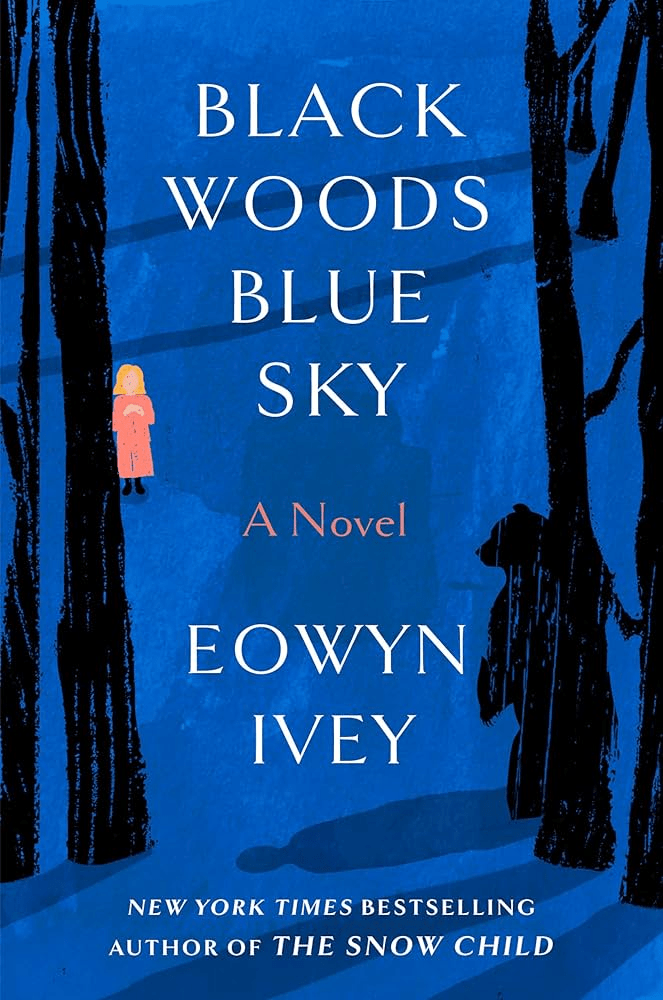
Birdie lives with her young daughter Emaleen in a cabin at the Wilderness Lodge in Alaska. She works at the Lodge as a night shift bar waitress and is struggling to support herself and Emaleen, oftentimes staying at the bar to drink and smoke. But she is drawn to the quiet and enigmatic Arthur Nielson, who has a strange air of excitement and even danger about him. Soon, Birdie and Emaleen move into Arthur’s cabin far away from the lodge, adapting to a rustic lifestyle. But Arthur is not what he appears, and the magical secret of his heritage may soon prove dangerous for Birdie and her daughter.
If The Snow Child was a gently evocative picture of life on a homestead in your gathering age, Black Woods, Blue Sky is a haunting account of getting in too deep with forces you don’t understand. That’s because this book is much more literal with its fantasy. There may or may not have been a real snow child, but in this case, there is most certainly a man who puts on a bear pelt and becomes a real bear. The dangers of The Snow Child were represented through winter’s fury, while Black Woods, Blue Sky shows the dangerous allure of a fairy tale that isn’t actually real.
Birdie yearns for something beyond life at the Lodge, as she’s always worrying about money and fending off criticisms about how she lives her life and raises her child. Honestly, though, they are valid criticisms. She often leaves her six-year-old daughter alone in their cabin so she can stay at the bar to drink and smoke and get high with the patrons. And Emaleen has to look after herself, sometimes worrying about where her mother is and whether she’s okay.
Birdie is a flawed and slightly immature protagonist, but she still very clearly cares about Emaleen. If there is danger, she will not hesitate to put herself between Emaleen and the threat, and she also gives Emaleen specific instructions about how to handle different dangers. When Birdie is around, Emaleen feels safe and loved.
That said, this book’s story is not very strong.
Birdie and Arthur are attracted to each other from the first page. We do not actually see them first meeting. I don’t think we even really see what draws them together, aside from the fact that Arthur is so different from the other patrons, and he has this tremendous sense of mystery that Birdie likes. But it evokes a teenage girl lusting after the bad boy sitting in the corner because he’s “not like other guys”, because Birdie comes strongly onto Arthur, and he barely engages with her. And why would he? He’s just minding his own business, when suddenly she starts bumping her hip against him and making sex jokes and other things that he is clearly uncomfortable with.
Arthur is the mysterious stranger that people tend to avoid because he doesn’t talk a lot and gives off weird vibes. For some reason, although he doesn’t do or say anything particularly noteworthy, or even that intelligent, Birdie thinks that is enough to upend her and Emaleen’s lives, and go live with him deep in the wilderness, far away from everyone they know. Birdie was essentially chasing a fairy tale within Arthur, and not a safe, stable life for herself and her child.
This is where I can understand people not liking Birdie. She makes decisions that put herself and her child at risk because she is so desperate for excitement and a small taste of danger. At one point, she decides that she’s just going to walk out onto the tundra for that small brush with danger, nearly getting herself killed, bar the fact that her daughter will be left alone with a man she doesn’t truly know. However, she does adapt to the rustic lifestyle, doing whatever she can to make everyone safe and comfortable in the cabin. I can’t say I like her as a person, but she was a compelling protagonist, which counts for something.
Apparently, this book was marketed as a Beauty and the Beast retelling, but it might be one of the shallowest versions I’ve ever read. Birdie and Arthur have no chemistry, no matter how much rough sex they have. It would have been very interesting if this was another growth opportunity for Birdie, for her to learn not only how to live with Arthur, but how to love him beyond just an immature fling. But Arthur is absent for so long that their relationship never grows.
Like The Snow Child, Alaska itself is a character. Half the story involves the characters wandering through the wilderness, adapting their home to the environment, and observing the plants and animals traversing the wilderness. Once again, I am in awe at Eowyn Ivey’s ability to convey the sheer wildness and beauty and danger of Alaska, but this time with a slightly more sinister fairytale edge to it.
Unlike The Snow Child, there is no mystery to the magic here. Arthur is, in fact, a magical being that can switch between a bear and man form by putting on a bear pelt. The legends about said creatures are common knowledge among the people, and they wonder sometimes if Arthur is one such creature, given his tendency to disappear for lengthy periods and his quiet, hulking figure.
But here’s where talking about this book gets tricky, because my biggest problem with the book’s story lies within a spoiler.
The book sets Birdie up as our protagonist: the person through which we will learn about this world and experience the story’s themes. She clearly has flaws that would make for a compelling growth arc. Unfortunately, about three-quarters of the way through, the perspective switches from Birdie to her daughter Emaleen, when the book jumps ahead at least fifteen years when Emaleen is an adult.
The time jump is jarring, first of all, to know Emaleen so well as a child to suddenly jump ahead to after she has graduated college. And I was simply scratching my head at the fact that Birdie’s arc was tossed aside in order to make one for Emaleen, who didn’t even need one to begin with.
I think the story would have been a lot stronger if Birdie was a through-line for the entire story. A struggling single mother is already a compelling main character, but a struggling single mother learning to not be impulsive for her child’s safety is tremendously more interesting than what the book did. Imagine if she took the same journey across the tundra as she did earlier in the story, but this time with less impulsivity and more care in order to protect Emaleen. I would have been thoroughly invested watching Birdie take what she learned and put it toward proving that she can be a great mother where it counts most.
But because we did not get that story, I’m left asking another question: what’s the point?
If we cannot watch Birdie grow and change to her full extent, then why were we watching her in the first place? If Emaleen was going to ultimately usher us into the grand finale, then why wasn’t she the focus the entire time? We also could have gotten a very compelling story from Emaleen’s perspective as a young child struggling with her mother’s impulsivity and growing up to confront a tragedy that destroyed her family. It leaves more questions than answers, and that is frustrating enough to drag the book down quite a bit.
Black Woods, Blue Sky’s story choices are so baffling that I was pulled completely out of the story when Emaleen became the main focus. The romance is also practically nonexistent. There could have been an absolutely incredible story of a mother learning impulse control to protect her daughter from a dangerous magic in the Alaska tundra, but so many opportunities were wasted within a shell of beautiful writing.


 The Library Key