

TRIGGER WARNING: This book review contains mention of child abuse and eating disorders. You have been warned.
My sisters and I bounced between the Disney Channel and Nickelodeon for most of our childhood TV time. We sometimes caught iCarly after school on Nickelodeon, and while I would certainly not call it a favorite of mine, I watched it enough to know the basics. But knowing what I now know about the going-ons at the network during that time, I feel kind of sick to my stomach thinking of Sam Puckett, the character that Jennette McCurdy played on iCarly, and what was happening behind that goofy tomboy veneer.
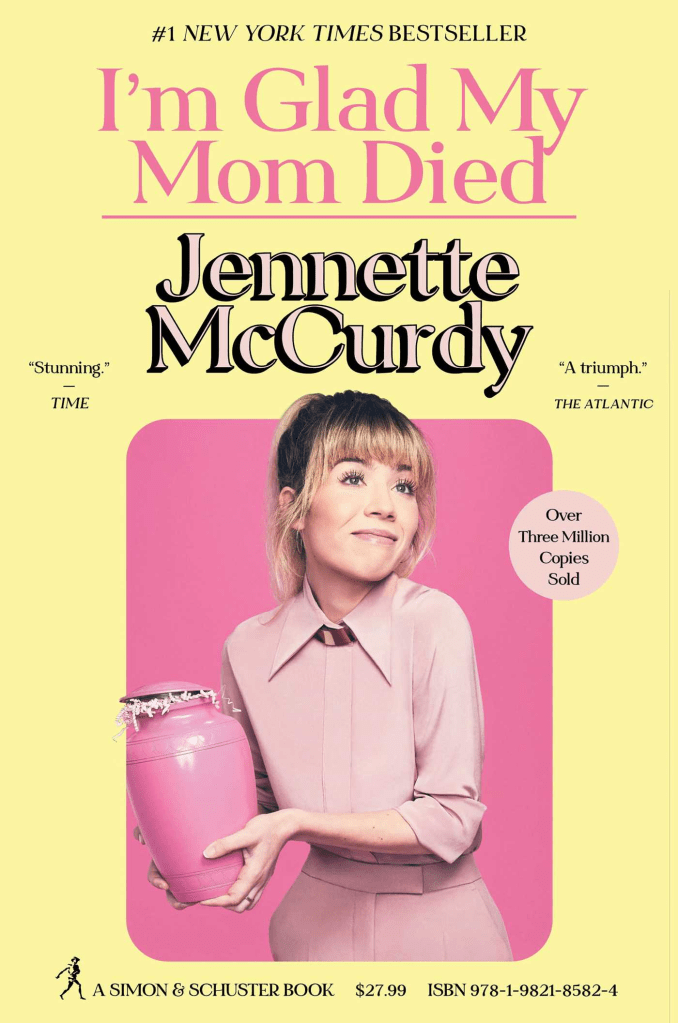
When Jennette McCurdy was six years old, her mother Debra asked her if she wanted to be an actress. Even though Jennette never gave it much thought, nor much enthusiasm, Debra convinced her that being an actress was her life’s ambition, and so the auditions began. But as Jennette’s career grows, Debra becomes more and more controlling over her daughter’s choices, including when she showers, what she eats, and where she can go. After Debra finally passes away from cancer, Jennette must confront her mother’s abuse and how she can finally move on to a healthier, happier life.
I remember vividly when I’m Glad My Mom Died came out a few years ago. It made an enormous splash on the mental health scene, with people discussing the nature of Debra McCurdy’s abuse of her daughter, and the alcoholism and eating disorders that Jennette developed from the trauma. I was shocked to know how bad Jennette had it while working at Nickelodeon. I knew that Dan Schneider, the channel’s forefront producer, had come under fire for sexual harassment allegations, but it was sad to know specifically how he affected Jennette (she refers to a particular producer as “The Creator”, and although she never says it is Schnieder, his name has come under enough fire that people are certain it’s him).
Of course, the big focus is how Debra corralled Jennette into an acting career she did not want. And truly, the things that this woman made Jennette go through makes me not want to view anything she acted in ever again, because you know that the whole time Jennette is filmed, there is a scared, confused, and hurting child saying her lines. Debra wanted desperately to be an actress, and so she decided to have that career through her daughter instead
At one point, Jennette became known by casting directors as “the kid that can cry,” because she was so good at crying on command. Casting directors tried to see how far they could take it, how hysterical they could get her to act. Although she might have turned in amazing performances, it was still emotionally draining to put herself in a headspace that helped her act well. And this is all before Jennette has turned ten years old.
Jennette was never allowed any agency in her career. Debra always spoke up for her when directors and casting directors addressed her and constantly gaslit Jennette into thinking that acting is her greatest joy. Not only that, but Debra introduced Jennette to calorie restriction in an attempt to maintain her young, undeveloped figure, which inevitably led to both anorexia and bulimia. Debra seemed to never want her children to grow up, constantly referring to Jennette as her “baby”.
There’s a particularly sad scene where a preteen Jennette writes her own screenplay, having discovered the joy of writing, and she shows it to her mother. Instantly, Debra says that the screenplay will not work because it is a direct copy of another famous movie, indirectly encouraging Jennette to give up writing. She even tells her she was afraid that Jennette had come to like writing more than acting, and they can’t have anything mucking up this blossoming acting career, now, can they?
While it’s good to know that Jennette had some support from her brothers and iCarly costars, the level of control Debra had over her is absolutely disgusting. Debra wraps everyone around her finger by flying into crying or screaming fits, even coming at Jennette’s father once with a knife when he comes home late. The ultimate goal is to make her happy, because you don’t want to be on the receiving end of a fit. Jennette feels like the parental figure in their interactions, acting like a mother trying to calm an oncoming tantrum, since the attention must be on Debra at all times.
Jennette paces this story near perfectly. Every anecdote about an audition or one of Debra’s tantrums adds to the larger story, and you never wish that things would go faster. That’s probably because Jennette never focuses on the intimate details of certain things, such as how Debra would shower Jennette herself, and do breast exams on her during these. She also drops the detail that she and her brother would be made to shower together until they were well into their teens, but that’s it. No details about what specifically happened with them together there: just that they were two siblings made to do an awkward thing well past the usual time.
Watching Jennette confront the reality of her mother’s treatment of her is truly heartbreaking. For her entire life, she’s been taught to do only what makes her mother happy, and leave nothing for herself; that her mother wanted what was best for her, and nothing else. She feels like a bitter, resentful shell of a person, and you want to reach into the book and give her a hug.
What’s worse is that Jennette cannot seem to find a solid relationship in wake of her mother’s death. She tries to form relationships with a few men, but they don’t work out, and her relationships with her father and grandmother fall completely apart. All she’s left with is alcohol and bulimia.
Jennette’s triumph over her past is amazing to witness. She was fortunate to have friends and doctors who gently pushed her along the path to recovery, and she worked hard to become a healthier version of herself. She had her slips, but she learned to give herself grace and keep going, finally getting the chance to learn who she was and grow into it. It’s terrible that her childhood and adolescence were given over to a career she didn’t want, and her mother commandeered her life to fulfill her own dream, but Jennette taking back control is the best slap in the face that she could give her “mother.”

 The Library Key