

I’m of the opinion that it is scientifically impossible to feel sad when consuming content related to Winnie-the-Pooh.
Winnie-the-Pooh was a huge part of me and my sisters’ upbringing, especially for my little sister. She had a Pooh Bear plushie with an attached honey pot that played a tinny version of the Winnie-the-Pooh theme when you pressed it, and her favorite blanket had Pooh Bear and Piglet on it. We three, though, watched everything from the Winnie-the-Pooh Disney movies, to every TV iteration of the characters (yes, even the infamously creepy Welcome to Pooh Corner). And when we took our first trip to Disney World, you can bet we sought out every character from the Hundred Acre Wood we could find.
Despite loving Disney’s Winnie-the-Pooh for many, many years, I’ve never actually read all the original A.A. Milne books. I was reminded of this when my family recently visited the New York Public Library, and we saw the original stuffed animals that inspired the stories about the world’s most famous teddy bear and his friends.
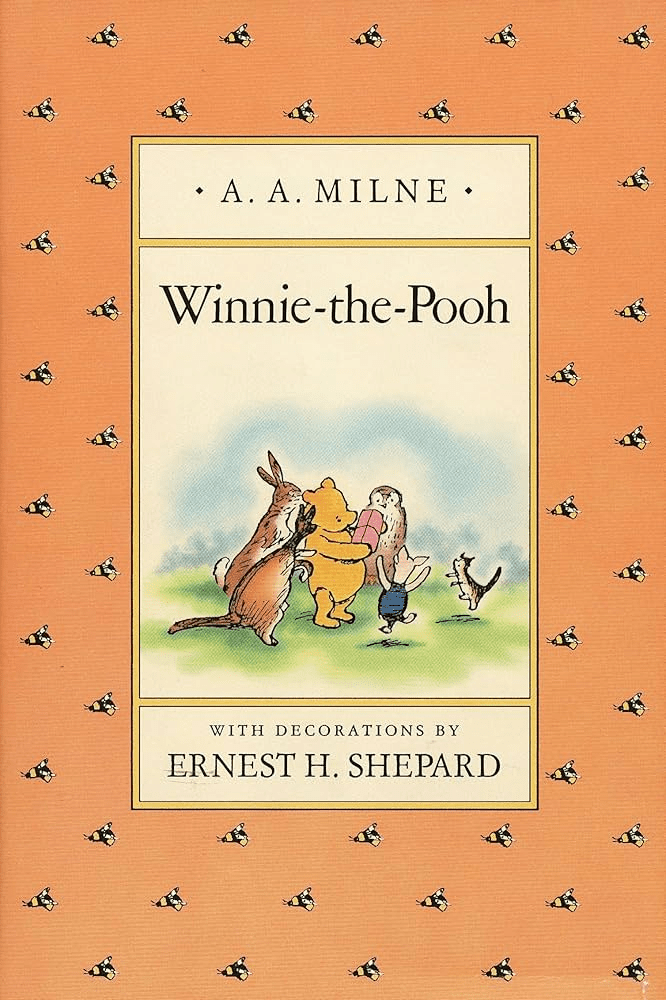
There is no overarching plot to each book. Rather, they are a series of adventures that Pooh Bear and his friends have in the Hundred Acre Wood. Each one is delightful, told like a bedtime story by Milne to his son, Christopher Robin. And frankly, I’m hard-pressed to find a concept more charming than these books: a series of adventures that a young child takes with their toy companions, all living peacefully and happily together in a special place only they know.
When Disney adapted these stories, they lifted a lot of the dialogue word-for-word from them. Milne’s writing tends to follow these amusing chains of events, often mirroring Pooh Bear’s thought process (“The only reason for making a buzzing noise that I know of is because you’re a bee. And the only reason for being a bee is to make honey. And the only reason for making honey is so I can eat it.”).
I can think of few characters as absentminded and one-track-minded as Winnie-the-Pooh that come across as charming more than annoying. For example, he learns one day that it is Eeyore’s birthday, so he decides to give his friend a pot of honey for a gift. But he gets the honey right when it’s time for elevensies, so Pooh absently begins to eat the honey, and before he knows it, he has just consumed Eeyore’s birthday present. Fortunately, Pooh is also resourceful, so he decides to give the pot as a vessel for Eeyore to keep things in. Pooh is certainly a bear of very little brain, but his goodnaturedness, resourcefulness, and optimism are endearing.
Speaking of Eeyore, the characterization in these books is excellent. Although Eeyore is gloomy and doesn’t expect anyone to pay attention to him, he is still glad for the little things. Both Pooh and Piglet’s presents for him are wrecked in their mishaps, but he is still very appreciative of their efforts. That said, he is a touch more impatient and grumpy than his Disney counterpart, often making passive aggressive remarks. Piglet, though meek and anxious, is also helpful and can also get impatient with Pooh’s short-sighted ideas, speaking in a severe manner that is unusual to Disney’s Piglet, but he is still generally sweet.
Rabbit and Owl also remain relatively unchanged from their Disney counterparts. I love how, when confronted with Pooh Bear, Rabbit once asks Pooh to pretend that he is not Rabbit, in case he is about to be pulled into an inconvenient or annoying adventure. The story of Pooh Bear getting stuck inside Rabbit’s front door after eating too much honey is still one of my favorite Winnie-the-Pooh vignettes, mostly thanks to the “Well, it all comes from eating too much” and “Well, it all comes from not having front doors big enough” comebacks.
And my goodness, Owl! When he is sent to rescue Piglet from his house in the flood, you would think he’d be smart enough to just fly Piglet out of the house. But instead of doing the sensible thing, Owl perches on a branch and “comforts” Piglet with a story as the water climbs, ignoring Piglet’s panicking. Owl acts like he is the smartest member of the group, but I think he’s actually the dumbest.
That said, I feel I must give special attention to Kanga and Roo, who go largely unseen in the Winnie-the-Pooh canon. When Kanga and Roo arrive in the Hundred Acre Wood for the first time, the others think that they’re strange and want them to leave. Long story short, Pooh and the others attempt to replace Roo with Piglet to frighten Kanga. But Kanga recognizes the joke, and decides to troll Piglet by giving him a harsh bath and making him drink horrible medicine. She even literally washes out his mouth with soap. She’s like, “Oh, all right, you want to take my child and think I won’t notice? I’ll just torture you until you give up the ruse.” It’s a pretty cruel turn on Pooh and the others’ parts, but I find it amusing nonetheless.
Tigger, surprisingly, is not very prominent, seeing as he doesn’t appear until the second book, The House on Pooh Corner. He is pretty much unchanged between book and Disney, always bouncing and claiming that Tiggers are the best at whatever activity he’s presented with, only to fail dismally each time.
That’s what I find so incredible about these characters. They are not very sensible, or even intelligent, and yet they remain charming and fun to watch. As much as I want to shake some sense into Owl, most of all, I can’t outright hate him.
I think we can all agree that the Hundred Acre Wood is one of the safest places in all literature. You don’t go there to have a life-or-death quest with intense episodes of gusto and self-discovery. Rather, you go to have amusing little adventures, where you ride an umbrella like a boat, or set a creative trap for a Heffalump. You know that everyone will be safe in bed at the end of the story, that mistakes will be forgiven, and that these friends will never abandon each other. It’s one of those places where everyone is content to “do Nothing”, and it’s just as wonderful as a day full of adventures.
And we can’t forget the famous last chapter of the second book, when Christopher Robin is going away to school and he and Pooh share one last scene together. It feels almost like a goodbye to childhood fun and innocence. Christopher Robin asks Pooh to promise that he won’t forget him, not even when he’s a hundred years old and Pooh Bear is ninety-nine, which, I won’t lie, choked me up. Of course, we don’t know for certain that this is Christopher Robin’s final visit to the Hundred Acre Wood, and the book ends with a hopeful notion that, no matter what happens next, there will always be a place for Christopher Robin and Pooh Bear to play together.
I think that’s what the Hundred Acre Wood represents for a lot of people: a place where childhood is tucked safely away, ready to be pulled out again when you need it. Pooh Bear and his friends are content to sit quietly, or going on an “expotition” at the drop of a hat. Everyone has their differences, but they all love and care about each other deeply. And in a world that feels more dangerous and unstable every day, we need places like the Hundred Acre Wood more than ever, just like we need Sesame Street and the Neighborhood of Make Believe.
I’ve heard Winnie-the-Pooh described as “the friend that never left”, and I agree. Even after all of us have grown up and left the Hundred Acre Wood, he is always there waiting, ready for another adventure or to just “do Nothing”. So I recommend you return to the Hundred Acre Wood when you can and enjoy all the simple but delightful romps you find there.


 The Library Key
I love this so much!
LikeLike