

Many domestic thrillers tell the same story: a picture-perfect suburban family (often wealthy, white, and Christian) is hiding a deadly secret that threatens their perfect image. But gosh darn it if that formula does not give so much space to play with everyday domestic anxieties and create powerful emotional responses. The Housemaid is almost as typical suburban thriller as you can get, but the anxieties it plays with still ring true enough to keep you hooked.
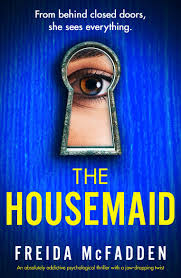
Millie Callaway has a troubled past and is looking for a fresh start. She gets a job as a housemaid in Long Island for the wealthy Winchester family, including businessman husband Andrew, housewife Nina, and their daughter Cecilia. But Nina proves to be an eccentric and uptight boss, making Millie’s job quite difficult and demanding. As Millie’s relationship with the Winchester grows, she uncovers some strange and disturbing secrets about them, but Millie’s descent into the Winchester’s hidden lives is only the beginning…
I admit, I was put off from The Housemaid at first because it made the rounds on BookTok. BookTok has a way of rabidly sensationalizing mediocre books, so I didn’t want to risk being disappointed by another misfire. But then, of course, the movie trailer starring Amanda Seyfried as Nina Winchester was released, and I was slightly more intrigued.
I like domestic thrillers because they expose the raw, ugly underbelly of bullshit hiding behind every “perfect” family. As much as many families want to give the impression that they are perfectly put-together, there are always chinks in the armor: insecurities and secrets that they would never show the outside world. These stories show that money, charisma, and privilege cannot stop their internal rot from inevitably slowly rising to the surface, and there is something so satisfying about that inevitability. Watching these shitty people lose control of their perfect lives, no matter how much money and privilege they have, feels like karmic justice for all the good people they screwed over.
The Housemaid gets going almost straight away. Nina only keeps up her facade of being a charming, immaculately put-together housewife just long enough for Millie to get the job, and then, the strange and confusing behavior escalates from there. I was a little surprised at how fast I felt something off about Nina, but I’d count that as a positive because it gets you engaged and guessing very early on.
On the whole, The Housemaid is pretty tropey. But what stuck out to me was Millie’s reaction to learning about a character’s severe mental illness. While she is surprised to learn about it, she is sympathetic to them, stating that it’s not a bad thing to have a mental illness as long as it’s being healthily treated, and that it’s not their fault they’re dealing with it. Most of the time, severe mental illness is played off for scares, as if the illness itself should be met with fear instead of empathy and compassion. It’s a small moment in the manuscript, but it caught my attention.
Of course, the book is not necessarily about mental illness as much as it is about characters in a desperate situation sprung from trying to appear perfect. Yes, they do very immoral things, but they were pushed to their limits and had to do what was necessary to escape. Before falling, of course, into the hands of lackadaisical law enforcement that did not believe their word. I know that probably sounds vague, but I’m trying to avoid spoilers, okay?
The characters, while engaging, are not particularly deep. Of course, that is mainly in service of a fast-moving plot and creating suspense, so I’m not complaining too much about that. The pace moves at a brisk pace and that helped me to keep reading, and I’m fairly certain no one’s asking for slow-burning character moments in a melodramatic story of jealousy and madness.
Another thing I like is that the book does not lay every little answer out. Everything feels resolved in the end, but there is a chilling element of every character’s past left out to leave us guessing the depth of all this depravity, and where it all started. It’s hinted that one character might have unresolved trauma from an overbearing, uptight parent, but it’s left vague enough to fill in the blanks ourselves.
All that said, while the book is very entertaining and it kept me reading in only two sittings, it is a very average thriller story. It’s not breaking any new ground, not even with its twist. It’s all executed pretty well, but again, it’s not a genius twist by any means. It’s not really enough to make me want to read the other books in the series right away, but maybe someday, who knows?


 The Library Key