

You all know the drill by now: Stephen King’s name pops up on this blog and I generally laud the author and the story he created. And that’s what I usually expect to write when I go into each of his books. I was a little wary of Cujo, though, because how could King build an entire novel around a rabid dog killing people? Peter Benchley tried more or less the same story with Jaws, and it didn’t quite work, mostly because the characters were strange or unlikable, and the shark went unheard of for most of the book. So, let’s see if a rabid dog can inspire more fear or tension than a killer great white shark.
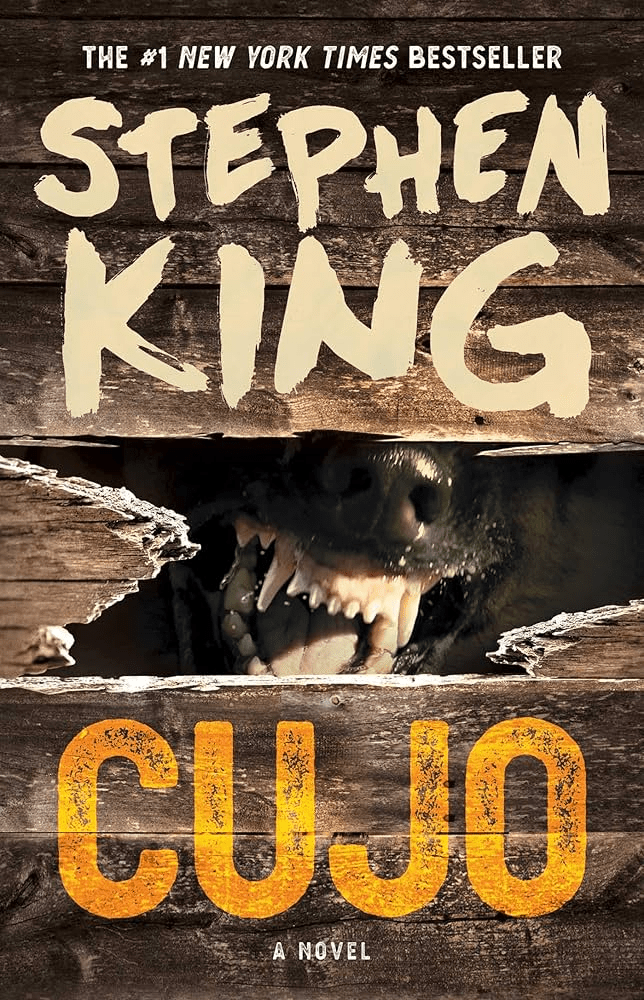
In Castle Rock, Maine, a sweet St. Bernard named Cujo follows a rabbit into a cave, where a rabid bat bites him on his nose. Cujo very slowly loses his mind to the disease, eventually killing several people in a blind, mindless rage. Cujo’s rampage shakes up the lives of his own family, the Cambers, and the Trenton family, father Vic, mother Donna, and their young son Tad. Things come to a head when Donna and Tad drive out to the Camber farm for a car repair, and their car breaks down near the barn where Cujo is hiding. Cujo sets his sights on Donna and Tad, trapping them in the car as the summer heat continues to rise…
I’ll say this right out of the gate: Cujo did the killer-animal-terrorizes-small-town story better than Jaws (the book, at least). Not sure if that is blasphemous or not, but at no point in this book did I outright hate a character or wish for the pacing to pick up, like I did with the other book.
But because the story is pretty thin, good chunks of the book are spent setting up the Cambers and the Trentons. And unlike the main characters in the other book, these people have interesting things to deal with and they are at least likable. Joe Camber may be an abusive alcoholic, but at least he never has any weird conversations about rape fantasies with a mistress (get used to the Jaws comparisons). The lengthy explanation behind Vic Trenton’s work problems might be a touch excessive, but at least he seems like a normal family guy who loves his wife and son very much.
Although the book bears Cujo’s name, the book doesn’t spend a lot of time with him. The story dips occasionally inside Cujo’s mind, but not for very long, and I wish we had gotten more of those scenes. It would have been quite effective if we got Cujo’s perspective while he was perfectly healthy, and to watch his personality change so completely would be very chilling. We probably only have one scene of Cujo interacting with people as a normal dog before he gets bit.
I think the story would have been a lot stronger if Cujo had a larger role. If we had seen how much the Cambers and their neighbors love him, as well as how much Cujo adores his family, the attacks would be more effective. That way, each time Cujo killed someone, we would be reminded of the sweet family dog that is turning more and more monstrous.
The nice thing is that a few of Cujo’s kills are implied rather than shown. The narration states when characters will see each other for the last time, and they are never heard from again after they encounter Cujo. Their bodies are never discovered, but we can imagine that every time Cujo retreats into the Camber barn, he is feasting on their corpses. For me, that’s the most chilling thing in the whole book: the fact that Cujo is eating the bodies of people who loved him and never, ever hurt him.
That said, at least the drama with the Camber and Trenton families is interesting. Vic Trenton is struggling to keep his ad agency afloat in light of their biggest account’s scandal, all while his wife Donna is coming out of a regretted extra-marital affair. Meanwhile, Charity Camber is struggling to ensure that her young son Brett isn’t tempted to follow the same destructive path as her husband Joe. The book dips into various different perspectives in the families, giving us a deep look at all this drama, but the story doesn’t really take off until Donna and Tad get trapped inside the car. Once that happens, it becomes a race against the rising summer heat and their depleting food and drink for someone to rescue them.
Donna and Tad are pretty helpless in this situation, because not only is the summer heat getting worse and they are running out of supplies, but they also have no way to call for help. And every time Donna glimpses some hope for rescue, it never comes. All the right inconveniences (including that this is the early 1980s and no one has a smart phone to make this a not-issue) are put in place to prevent anyone from coming to the Cambers’. And if they do, well, Cujo is always waiting.
Since this review is about Cujo, it seems I am obligated to mention how shocking the ending was. I was not expecting it, and it certainly left me feeling sad about the injustice of it all. All this happened because one dog went rabid, and a series of unfortunate coincidences could not prevent the ensuing tragedy. I suppose that is one other discomforting thing about this story.
I would put Cujo in the same camp as Christine. Cujo himself is still a Stephen King icon, and there are some tight, tense scenes, especially during Donna and Tad’s entrapment. But if Cujo were a greater narrative presence, his transformation would have been more heartbreaking and the ending much more morbid. The book famously states that Cujo only just wanted to be a good boy, but I’m not sure that was enough to make it great.

 The Library Key