

I love Disney, plain and simple. Actually, to say I merely love it is an understatement. Every time we were asked to do a school project on a historical figure, I called dibs on Walt Disney. Every time there is a choice of movie to watch, I’ll gravitate toward a Disney flick. Whenever I’m in the mood to sing in my car, my Disney playlist is ready to go. Disney is literally a part of my everyday life, and it shaped me in ways I cannot even begin to describe.
I genuinely don’t think I would be who I am without the undeniable influence of Disney. My values are linked with the brave, compassionate, and kind characters I’ve been watching for the last thirty-something years. As a lonely, undiagnosed neurodivergent kid, I found inspiration and comfort in characters like Quasimodo, Hercules, Mulan, Snow White, Merlin, and so many others. And I would not have experienced these characters or their stories without the films that Disney put so much love and effort into.
Just a heads-up: this review is not necessarily about the quality of this biography; it’s good. My perception of Walt Disney changed a lot after reading it, and this is me parceling out all this new information and finding some new realizations about a figure that I’ve been fascinated with my whole life.
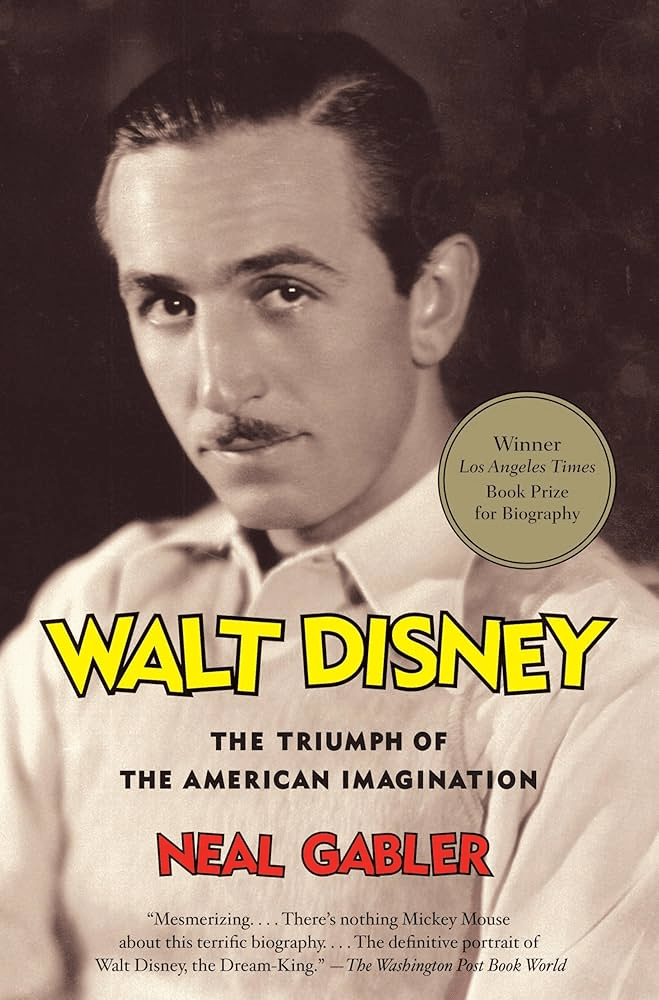
The story of Walt Disney has always been a compelling one for me. He came from a poor background in Marceline, Missouri before he founded his first film company in Kansas City, where Oswald the Lucky Rabbit and Mickey Mouse put Walt on the map. As Walt and his crew moved from making animated shorts into feature-length films, Walt never stopped pushing himself or his crew to do bigger and better, and by the time of Walt’s death, his name had touched movies, books, music, toys, clothing, radio, television, and theme parks. I’m pretty sure no other name in entertainment has reached quite as wide as his.
I used to believe that the warm and jolly “Uncle Walt” personality from television specials and behind-the-scenes footage represented the actual Walt Disney. But, surprise, surprise, Walt was a complex and flawed person who had faced a lot of tragedy and hardship, and he spent much of his life trying to face down those tragedies.
For example, Walt and his brother bought their parents a new house with the money that they made from their animation success. But a gas leak occurred within the house, and Walt’s mother Flora was killed. Walt felt an enormous amount of guilt for his mother’s death, believing for a long time that he was responsible for the tragedy. Is it any coincidence that a lot of Disney heroes and heroines also don’t have a mother?
As a child, Walt and his older brother Roy endured abuse from their father, Elias. Elias would often beat both Walt and Roy with a belt if they didn’t complete their paper routes the way he wanted. Walt spent several decades trying to earn his father’s approval, putting an undue amount of pressure on himself to do better and better. Behind closed doors, Walt was an incredibly self-critical person, and sometimes that pressure would leak out to his crew. Walt infamously never gave very enthusiastic praise, although he would often reward his crew with extra pay for their ideas, and he would give them bonus money to buy them all dinner and drinks after a good day’s work. He gave his animators enough motivation to do great work and also let their personalities and talents shine.
That said, having now read such an extensive account of Walt’s life, I cannot look at his animated films the same way. For all the innovative success Walt found in making animation an art form, it created a lot of strife among his staff members and every moment of finished animation was produced through relentless criticism, brought on by Walt’s obsession with perfection. He could pick up details in an animation reel that no one else did, and no matter how small the imperfection, he would demand that the scene be redone. It sounds as if he had a hard time communicating what exactly he wanted, and it was left up to his staff to piece together that vision with scant direction. And when they could not read his mind exactly, Walt could get moody because he would have to re-communicate the idea, and inevitably, the crew would only get a little closer to realizing it.
It’s not a novel speculation by any means, but I cannot help the feeling that Walt might have had some undiagnosed neurodivergence. The way he would intensely obsess over something before losing interest, not being able to communicate effectively, his isolation, and his rapid-firing ideas reminds me of autism or ADHD. As a person with AuDHD myself, I recognize those characteristics in myself and other neurodivergent people. Again, who’s to say whether Walt Disney was actually neurodivergent, as he was never formally diagnosed, but it might explain parts of his personality.
Perhaps as a result of his childhood trauma, and some issues he suffered with studio execs early in his career, Walt wanted absolute control in his studio. He tried to create a fantastical utopia in his animated pictures where every frame was exactly what he envisioned, and where he could invite other people in to enjoy it with him. He obsessed over that animated utopia for a time, but when it failed to return sufficient profits and the animation quality dipped after a strike in the 1940s, he never quite found satisfaction in it again. The animated film catalogue that Walt supervised contains almost twenty films, and knowing that he slowly stopped caring that much about these films is not what I expected to read.
I can count on one hand all the movies his studio made that he was truly excited about, such as Snow White, Fantasia, and Mary Poppins, perhaps in part because they all broke new technological ground. Walt adored technology, and that’s part of why Disneyland would eventually consume him so much: not just because he would be able to bring his magical inner world to life, but because evolving technology would continue to bring that world to life long after Walt was gone.
If Walt obsessed over pushing animation, he threw himself heart and soul into making Disneyland the physical embodiment of the utopia he sought in animation. It was all he would talk about, all he would think about. And even after the park was finished, and millions of visitors poured through the gates year after year, he would continue to find things to work on. As he famously said, Disneyland would never be finished.
Walt was a profoundly lonely individual. Although his name was known the world over, and people scrambled to consume everything his studio produced, he didn’t have many close friends and he struggled to make connections. His mind seemed to move so quickly and he had such a hard time articulating his thoughts. Walt had an intense inner world, and it seemed he was eager to explain his own inner world in any way he could.
In the end, Walt Disney was a flawed and complicated man that had a grand vision, but never quite found satisfaction in it. He said shortly before his death that he would feel very disappointed if his whole legacy amounted to creating a cartoon mouse. And while Mickey Mouse will forever be tied to Walt’s name, his name still creates a grand tapestry of dreams and comfort, of good triumphing over evil, and curiosity creating positive progress. It might not necessarily be the legacy he wanted to leave behind, but what he gave to the arts and entertainment is a legacy beyond what anyone can ask for.
I really appreciate Walt’s gumption and his drive. If he had an idea, nothing was going to stop him from creating the absolute best version he could make. It’s a little disappointing that he didn’t have as solid a relationship with his animated films as I thought, and the Uncle Walt image has been broken. But, at the end of the day, he had good intentions, unabashed enthusiasm, and childlike joy in pushing the boundaries of art and entertainment.

 The Library Key