

The Green Mile is an evocative title for me. I remember in 1999 seeing the Tom Hanks movie poster appearing on one of those scrolling paper ad screens you saw in shopping malls. I was also astounded to learn that The Green Mile, one of the most emotionally-heavy stories of the last couple of decades, was written by the horror master himself, Stephen King. Of course, I’m not surprised by this point that King can write great non-horror stories, so I was ready to see how he could write a straight-up human drama.
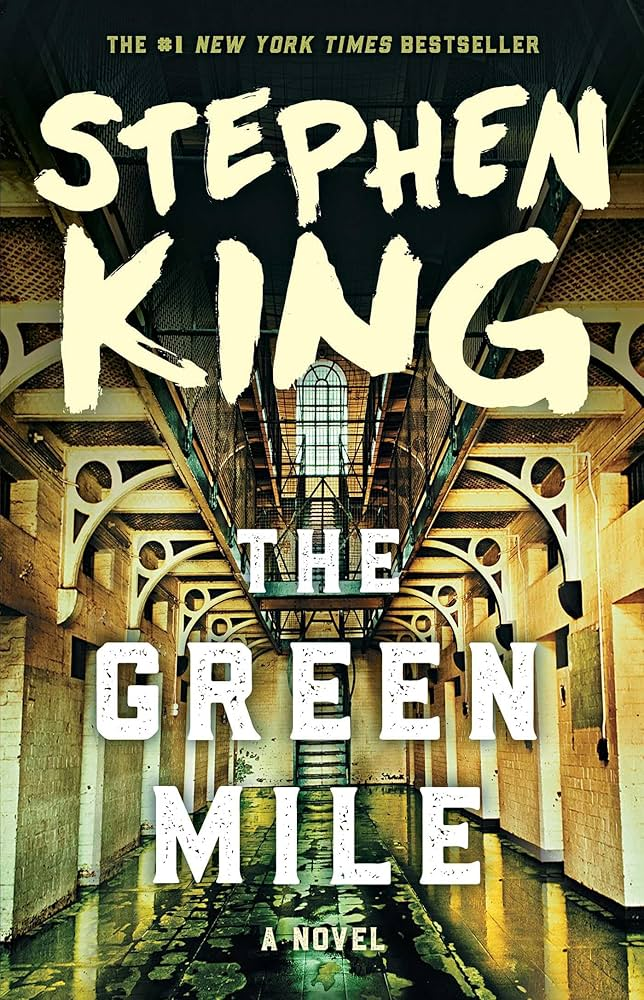
In 1932, Paul Edgecombe works as the superintendent of E-block, a.k.a the Green Mile, at the Cold Mountain Penitentiary in the American South, where he and his crew supervise the death row inmates. Their ordinary work lives are shaken up by the arrival of John Coffey, a tall Black man convicted for the rape and murder of two young girls. Paul discovers that John has an extraordinary healing gift, and he struggles to understand how a man with a gift like John’s could have committed such atrocities. But there is more to John than meets the eye, and their encounter will change everyone working on the Green Mile forever…
Yes, The Green Mile is emotionally heavy at parts, but I found it a surprisingly comforting story to consume. Part of it comes down to the camaraderie and respect between Paul and his coworkers Brutus, Harry, and Dean. The other Green Mile guard, Percy Wetmore, is an entitled and sadistic man who is only there because he is the governor’s nephew, and he does some sick and terrible things to the inmates, knowing that his government connections will protect him from consequences.
The most important thing about Paul’s work is ensuring that the inmates are comfortable before their death sentences are carried out. One of the inmates, a Cajun man named Del, makes friends with a resident mouse dubbed Mr. Jingles, who distracts him and gives him happiness. But because Del had the nerve to laugh at Percy one time, Percy forms a vendetta against Del, and with just minutes before Del is due to die, Percy makes those final moments absolute hell for Del and all the witnesses of his execution. And because Paul and his crew protect each other and set some firm ground rules against Percy, you see how committed these men are to their work and to each other.
The first half of the book is pretty slow, as we just watch Paul and his crew tend to the current inmates and receive two new ones, including John Coffey, who doesn’t really become a prominent character until the latter half. Till then, Paul tends to his home and work lives, Del grows closer to his mouse, and Percy is an entitled little shit. There are lots of subtle, gentle moments here, and although you never forget that this is death row, you respect Paul and his crew for being good to the inmates every step of the way.
The story doesn’t pick up until Paul learns about John’s healing gift. After that, the question as to whether John actually belongs on the Green Mile becomes greater. Paul and his crew struggle with whether it is right to execute someone with a seemingly divine gift, one of them pointing out that they would be killing someone specifically blessed by God, which could condemn them all. But it’s clear that they are all bound by their jobs’ rules, and they must continue with the execution for their own survival during the Great Depression, much to their heartbreak.
I think what makes this book so soothing is the gentle pacing and the sense of nostalgia throughout. The book is written as a memoir by an older Paul, who is now living in a nursing home. Although he talks about some heavy things, it is sweet that he looks back at his relationships with his crew, his friends, and his wife with bittersweet fondness. And although the Green Mile is the place where prisoners come to die, it’s not run by evil men. Again, Paul and his crew are kind and respectable: the kind of men you would trust to keep you safe.
And yes, The Green Mile did, in fact, make me cry. Every second leading up to the climax, I was blinking away tears, and when grief crashed down over the characters, it crashed over me too. I knew what was going to happen, and yet I was pleading “No, no, no” with the book to not go there. And when it did, I broke like a dam.
Unlike Cujo, another Stephen King story that included a lot of unfair and unfortunate coincidences, the sense of unfairness and injustice in The Green Mile affected me a lot harder. It’s another story where the most dangerous monsters are not the ones under our beds, but the sadistic and prejudiced people walking among us: the racists, the uncaring, the selfish, who destroy good things because they don’t suit their ugly worldview or don’t serve their own disgusting ego.
John Coffey is a tragic character whose goodness went unseen because of human prejudice and blind hate. He tells Paul that he is tired of being alone in the world, and of people simply being ugly to each other: that he can feel the hatred of mankind like glass shards in his head every minute of every day. That’s how empathy can feel in a world that seems to reward evil and punish good. And in the year 2026, that sentiment by itself is enough to make one tear up. You’d think we would be a more enlightened society almost one-hundred years after this book took place, but there are still too many people who would be glad to see a good man like John Coffey suffer.
King is a strong writer no matter what genre he writes, but The Green Mile demonstrates he can do regular human drama very well. It’s haunting and heavy, but surprisingly bittersweet thanks to its good human characters and their quest to maintain dignity and respect in light of injustice and death. It’s rightfully called a masterpiece among fans, and I’d say it’s earned a place in my top ten Stephen King books.


 The Library Key