

It’s so interesting to observe trends in literature during certain periods in time. For example, dystopic young adult literature was all the rage during the early 2010s, but when a certain someone took power in the U.S., it suddenly wasn’t as much fun to read about corrupt governments and resistance groups led by plucky teenagers. And now that that certain someone has taken power again, this time, I’ve seen a few books where people take action specifically against fascism and unrelenting tyranny. A Resistance of Witches is one of those books, imagining a fight against Hitler and the Third Reich in an underground world of witches.
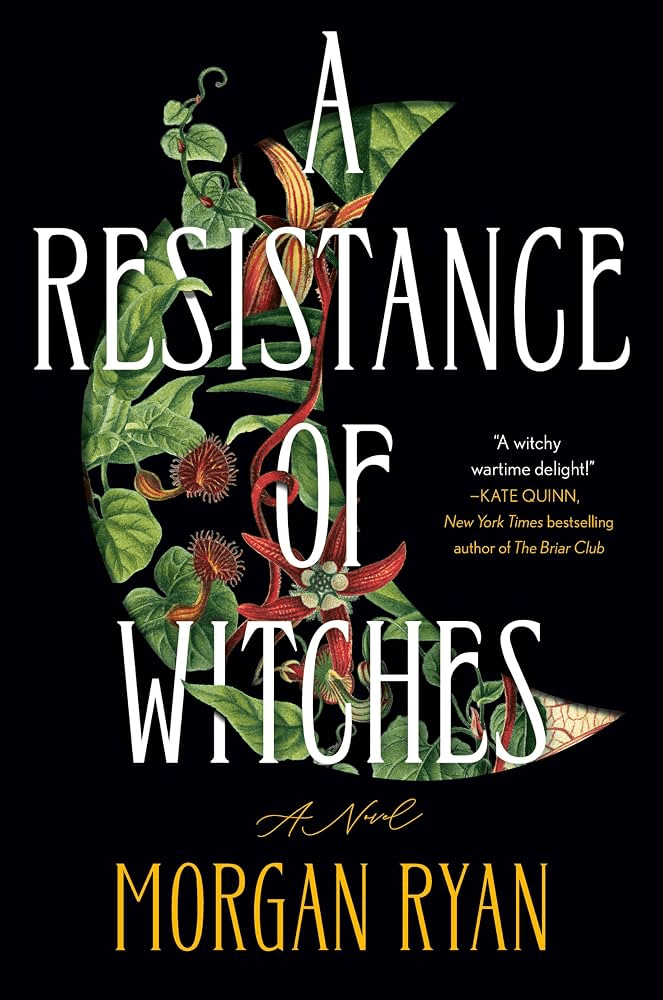
Nineteen-year-old Lydia Polk is set to become the Grand Mistress of England’s witches. But her world is plunged into chaos when a German witch infiltrates the Royal Academy of Witches and kills her mentor. She soon receives an assignment to find the Grimorium Bellum, a dangerous grimoire full of spells that, if harnessed by the witches of the Third Reich, could bring about the end of the world. Lydia teams up with Rebecca, a Jewish resistance fighter, and Henry, an art scholar, in order to find the book and destroy it…
There is a popular idea that the United Kingdom defeated the Nazis in World War II because all practicing witches combined their wills to prevent an invasion similar to France and Poland. This book takes that idea and runs with it, showing witches doing their part on behalf of England in the war effort. Except the witches are split between those who don’t care what happens to England, since many still carry scars from the witch trials, and those who want to fight against the objective evil of the Third Reich. Both sides are valid in their choices, and it’s fun imagining a world where witches became underground soldiers for their countries during this conflict.
Lydia is a principled perfectionist who believes thoroughly in fighting for justice. Her drive to protect her country, in spite of the terrible things it has done to her kind, is very noble. She sees beyond the horrors of the past and wants to protect all people from falling victim to the Third Reich. But she can be uptight and does things by the book, so she sometimes needs other people to think outside the box.
I liked how Lydia was skilled, but she didn’t have any more power than any other witch. She needs other witches with different skill sets to get the job done, and that sense of sisterhood and camaraderie is prevalent in many magical rituals throughout the story.
Rebecca had the most compelling backstory. As a Jewish girl, she watched her family get taken away by Germans, never to be seen again, and so she joined a resistance group in France. All she has left is her own car, which she refuses to let anyone else drive, and it’s her small, moveable sanctuary in a world that seeks to destroy her. Rebecca is understandably furious about her family’s loss and the Third Reich’s unrelenting cruelty, so she will do whatever is necessary to stop them, even if it means murdering a few people along the way.
That’s a key difference between Rebecca and Lydia. They are both determined to see the Nazis defeated and are capable fighters, but Lydia is guided by her training and principles, refusing to stoop to murder, whereas Rebecca has no qualms about killing any Nazi that gets in her way.
However, the story squeezes both Rebecca and Henry’s backstories into just a couple of chapters, before we get right back to Lydia, who becomes separated from them in the latter half. It’s kind of disappointing that they don’t play larger roles in Lydia’s mission. Lydia pulls the most weight in the end, while Rebecca and Henry really only help each other in escaping the Nazis. If there was a more cohesive, balanced relationship between the three, and they played more equal parts in defeating the bad guys, the ending might have been a touch more satisfying.
But what took me out of the story most was probably the most inconsequential thing about the whole thing, and that is a brief romantic subplot between Henry and Lydia. There are some stories where a romantic subplot is not necessary, and this book is one of them. Of course, it only lasted for two chapters and added nothing to the overall story, so it might as well have not been there at all.
It also would have been pretty cool if we had seen some more battle scenes between English and German witches, mirroring how non-witches would have been fighting at the same time.
The best part of this whole book was the evolution of Lydia’s mother, Evelyn. She is a witch who works “low magic” with Tarot cards and tea leaves. But she actually proves to be much more powerful than people give her credit for. I love characters who appear to be meek and relatively powerless, but then prove themselves far greater than almost anyone else in the cast, showing that you should not underestimate people’s capabilities.
Without spoiling anything, there is a scene where Evelyn’s powers are so calculated and practiced that, although she is face-to-face with a dangerous adversary, she still maintains her kindly nature while at the same time not allowing her enemy to intimidate her. She is the definition of a sweet English country woman who will make you a pot of tea without asking, but if you cross her or her family in the wrong way, you will be sorry.
For the impact that Evelyn has later on in the story, I wish we had gotten more scenes between her and Lydia. Or, at least, Lydia had spent more time thinking about her and regretting the relationship that she never really had with her mother.
There is a bit of a clumsily-handled red herring in the book, though. We are led to believe that someone in the Academy is a secret Hitler loyalist, and when that is finally revealed, it’s not entirely surprising. I suppose it does make it kind of sickening to hear such awful, hateful rhetoric coming from such a sugary sweet person (it gave me Dolores Umbridge vibes, I won’t lie). But the reveal wasn’t as shocking as it should have been.
There are some good parts of this book, but it is far from perfect. If you’re looking for an engaging and action-packed story about witches in conflict during World War II, it should satisfy well enough, if you can look past the minor narrative flaws.


