

People complain nowadays about there being too many adaptations of Stephen King’s works, but I think people are sick of seeing the same works being adapted over and over again with pretty disappointing results (looking at you Carrie and Pet Sematary). So I don’t think people were that irritated about The Long Walk, one of the earliest novels King ever completed, finally getting a movie. The concept was intriguing enough that I decided to read the book before I saw the movie. For the first time in a long time, perhaps even ever with a Stephen King book, I found my anticipation turning into disappointment.
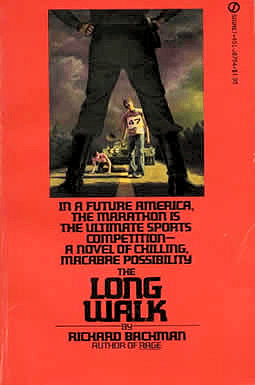
In the near-future, dystopic United States, Ray Garraty is one of one-hundred teenage boys selected to participate in the Long Walk, an annual event where the participants walk without rest until only one person is left standing. The rules are simple: keep walking at a brisk four miles an hour, and never fall under that speed, because failing to maintain speed three times means “buying a ticket”, or getting killed by the chaperoning soldiers. What seems like an easygoing walk at first turns into a struggle for survival, since there is no shelter from inclement weather or the increasing physical and psychological torture…
I had never heard of The Long Walk until the movie was announced. But I was impressed to learn that it was one of the first novels Stephen King ever worked on, beginning the manuscript while he was only a freshman in college, though he didn’t publish it until many years after he had published his first novel Carrie. And even then, it was published under his pen name, Richard Bachman. And it certainly reads like an early, early novel.
To be clear, the writing is not terrible in The Long Walk. It is still compelling, but there are some cliche writing choices and it doesn’t feel as polished or complete as his other books. It is possible that this unpolished, incomplete feeling comes from some deliberate story choices, such as wanting to leave the world around the Walkers intentionally vague. But part of my curiosity with this book was learning more about this twisted United States: how it transformed from the one we know and how the Walk began. I know there are people who would prefer ambiguity so they can fill in the blanks themselves. But given King’s mastery of horrific description, it would have been chilling to hear about the country’s bloody and twisted metamorphosis, and the genesis of the Walk.
One thing is clear in this story: the Walk is not something that people hate because it means watching innocent teenage boys die horribly. Every time the Walkers encounter crowds of spectators, these crowds are scrambling to see them, and even to touch them, as if these doomed boys are rock stars instead of pigs heading for the slaughter. They are absolutely losing their minds, falling over themselves to get close to the Walkers. It’s quite disturbing to picture.
I would have really loved to learn more not just about this twisted country, but the Major, the “socially-accepted sociopath” who appears to lead it. He is shrouded in mystery, only appearing now and then to salute the remaining Walkers. I feel like there was an opportunity wasted in making this man an imposing, bloodthirsty killer who presents himself as a patriot, but actually revels in innocent people’s destruction. Perhaps one of the Walkers had an inside look at the Major, and we hear just how depraved and two-faced this man actually is. Perhaps he took advantage of a floundering country, slowly convinced the public that televised slaughter was good for patriotic morale, and he is erasing any possible way he could lose power. After all, he has created a country where speaking against this regime is punishable by death, so why not show those consequences throughout the manuscript? It is suggested that there is some sick patriotism in a Walker happening to die on the soil of his home state, but again, just a little crumb.
There is a surprising amount of restraint in this story. In this case, though, I think that’s a point against it. I was hoping to hear a lot of horror stories from previous Walks, about how truly sociopathic the Major and his soldiers are: to feel the weight of how treacherous this regime is. I was expecting a heavy cloud of dread and gloom to hang over the boy’s heads, for some gory and awful injuries incurred from the Walk. The boys do encounter some dangerous weather a few times, but that’s the extent of the outside threats.
That’s the most disappointing thing about this book: that it didn’t go as far as I hoped it would. The struggle to keep on walking, despite all the horrors described above, would have made the stakes feel so much higher. It doesn’t seem as though Ray struggles all that much during the Walk. Sure, he clearly suffers a few psychological horrors now and then, but we don’t ever feel scared for his safety. That’s the tricky thing with a story where there can only be one survivor: either you work in a twist at the end, or you commit to the bit and kill them off.
There is one pretty sad part, where one of the Walkers realizes that no matter how he pushes, he will not finish the Walk. So he walks around saying goodbye to everyone before he sits down on the road and waits to be shot. This is effective because we understand his reasons for being in the Walk, and what he has to lose from not completing the race. There are stakes with this Walker, and there is weight to his loss.
Ray, on the other hand, has no clear reason for why he’s in the Walk. He may be our audience surrogate in this event, but all we know is that his father spoke out against the regime and the Squad took him, as well as that he is hoping to see his mother and girlfriend in an upcoming town. He is not in it to save his family from destitution, nor does he have any specific favor that winning could grant him.
Given all this dystopic bleakness, the voyeurism of violence, the children-on-children conflict, one definitely wonders if Suzanne Collins took some inspiration from this for her Hunger Games series. Also kind of funny how the guy who directed almost every single Hunger Games movie went on to direct the movie adaptation of this book, but anyway.
The ending (no spoilers, don’t worry) wraps up way too quickly. I was hoping to see what the aftermath of the Walk looked like, whether there was any recovery for the winner, but the Walk ends, and that’s pretty much the end of the book. I turned the page hoping for more resolution, and I actually blinked at seeing nothing else after that. I think that was the moment I knew I had my first Stephen King dud.
Again, I don’t think this is a terrible book. But the best Stephen King books at least have a compelling kill, intriguing monsters (human or otherwise), and some heavy human commentary. The seeds were there for another really good one, but sadly, I’m walking away from this one feeling more let down than anything else.


