

‘Tis always a sad day when one reaches the last book in a gripping multi-book story. But I came into The Magician’s Land with two images in my memory: the character of Plum, and Quentin looking into a mirror inside a house within a new magic land. I looked forward to seeing those images fit themselves into the full story, but I did not remember what a slow start would come with them.
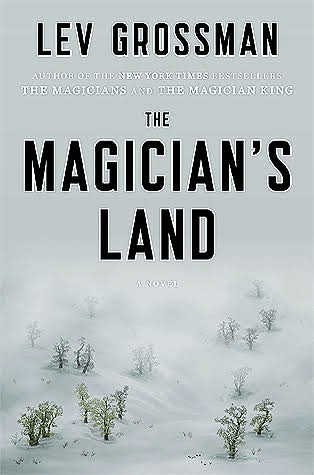
After being exiled from his beloved land of Fillory, Quentin finds himself adrift in the real world again. He soon finds himself back at Brakebills, where he becomes part of the faculty in an attempt to rebuild his life. But he quickly receives a mysterious invitation to join a magical heist to retrieve a special suitcase from a criminal magician couple. Meanwhile, back in Fillory, Eliot, Janet, Josh, and Poppy receive a disturbing prophecy about the future of their new home, and they race to save it before Fillory is doomed forever.
The beginning of this book is a slog, I won’t lie. Things get a little more interesting after Quentin leaves his cozy faculty life at Brakebills and joins the thieves. But even after we understand what Quentin and the other thieves are trying to steal, I found myself wishing to return to Fillory. And luckily, we do.
What I like most about this book is the in-depth look at the lives of the Chatwin siblings, who first discovered Fillory during the 1910s. We see firsthand how they discovered the entrance to Fillory inside the grandfather clock, and also what caused them to leave it all behind for good. It’s very bittersweet watching this group of traumatized siblings discover the wonder and majesty of ruling a faraway magical land, only for them to lose it all because of a few selfish choices. These siblings believe they have found a new home, but they discover that Fillory is just as cruel and unpredictable as the world they tried to leave behind.
The lore of Fillory and the Chatwins has been sprinkled throughout the trilogy, but this was the last place to lay down the entire story, and I almost found it more interesting than the magicians’ adventures. A firsthand account from Rupert Chatwin, the middle sibling, lays down all those cards, and it takes over the book for a while. It’s gripping enough that you almost forget about Quentin and his friends. I wish Lev Grossman had actually written the Fillory and Further books so that we can see the complete picture of the world that led Quentin to becoming a magician in the first place. Sure, it would essentially be a retread of the Chronicles of Narnia, almost story beat for story beat, but I still adore any adventure where a group of siblings visit another world that completely changes their lives.
But then we get to the final third, when the end of Fillory arrives, and the need to find a cure is more desperate than ever. While the description of the Fillorian apocalypse goes on a little longer than necessary, this is our heroes’ home, and it’s a morbidly grand display to watch all the beautiful things about Fillory inverted or destroyed.
This book really takes its time setting the scene, whether it’s reintroducing an important character to the plot, or watching Fillory’s awe-inspiring, Revelations-esque ending. I wouldn’t call that a bad thing, necessarily, but you do notice just how long these scenes go on, and it only slightly takes you out of the story.
The scope of this book feels the greatest of the trilogy. Although Quentin and Julia traveled extensively in the second book, this time, we see Brakebills, Fillory, the heist, and the two new lands created from a Chatwin spell.
And with that scope comes a lot more growth. The difference between the Quentin from the first book and the one from this book feels like night and day. While younger Quentin was definitely angrier and more depressed in turns, this one feels a lot more grounded and better able to step up. That still doesn’t make him the most interesting character in the book, sadly, but at least he has a colorful and memorable cast around him.
This is a pretty enthralling last chapter in the trilogy. The action is pretty swift when it finally arrives, but the fact that it starts out so slow probably makes it my least favorite book in the trilogy. To be clear, each book is good, and I like different things about each one, but this was the only book where I paused reading because I was so bored with the start.
And so, we’ve reached the end of the trilogy. Surprisingly, not much has changed from my first readthrough almost ten years ago. I still like the jaded adult cynicism meeting the yearning whimsy of classic fantasy adventure. But most importantly, the grand, magical journey is still gripping and fun to experience alongside these flawed but compelling characters. Like any good series, I feel like I’ve taken an adventure and I’m taking something with me at the end of it. The second book is probably my favorite of the three, though that might be a hot take among fans.
At any rate, I’m glad I re-took the journey through Fillory, and I might again in another decade, when I’m ten years wiser and wearier than I am now.


